




Garbage In, Alpha Out?
Why data quality will decide who wins with AI in Fixed Income.
Byron Cooper-Fogarty, former CEO of Neptune Networks.
 Garbage in, garbage out is a truism in many aspects of life, not just the fuel of the Artificial Intelligence (“AI”) revolution. In Fixed Income (“FI”), a complex and data-centric asset class, this is doubly true. The use of AI in Fixed Income, and the impact on P&L and fund performance, is only as good as the data beneath it.
FI’s fragmented nature with 50,000+ issuers and millions of individual bonds and related derivatives means the data is equally fragmented and often patchy. Models trained on patchy data will deliver patchy results. In a highly regulated industry, that simply isn’t acceptable. Liquidity is equally patchy for the same reasons, as such data is often derived rather than observed. AI models can take this data as market truth and amplify the feedback loop.
The other core dataset, beyond pricing, is reference data. The unglamourous and, in my experience, too often inconsistent backbone of FI. One error in industry classification (a personal bugbear), ISIN, CUSIP, credit rating, callable status, capital hierarchy etc. can break a model, even when the pricing data is of the highest quality.
AI raises the stakes on FI data quality. Automation scales errors faster with bad data feeding algorithmic RFQ routing, auto-pricing, or portfolio construction before a human can spot it. LLMs and agents introduce new failure modes such as overconfident answers drawn from unverified or stale sources or hallucinating terms from prospectuses. Explainability and audit trails are vital for regulatory reasons (e.g. MiFID II best execution, SEC/FINRA rules, model-risk guidance like SR 11-7), and they depend on data lineage.
The good news is that AI can be a big part of the solution, in conjunction with human sign-off and supervision. Extracting terms from prospectuses and term sheets, using the persona of a market expert, as well as entity matching, anomaly detection on quotes, and cleaning dealer axes and runs. Whilst AI demands quality, it can also help enhance it – not all market participants are as open to being part of the solution!
Garbage in, alpha out?
Data quality decides whether AI helps or hurts in fixed income
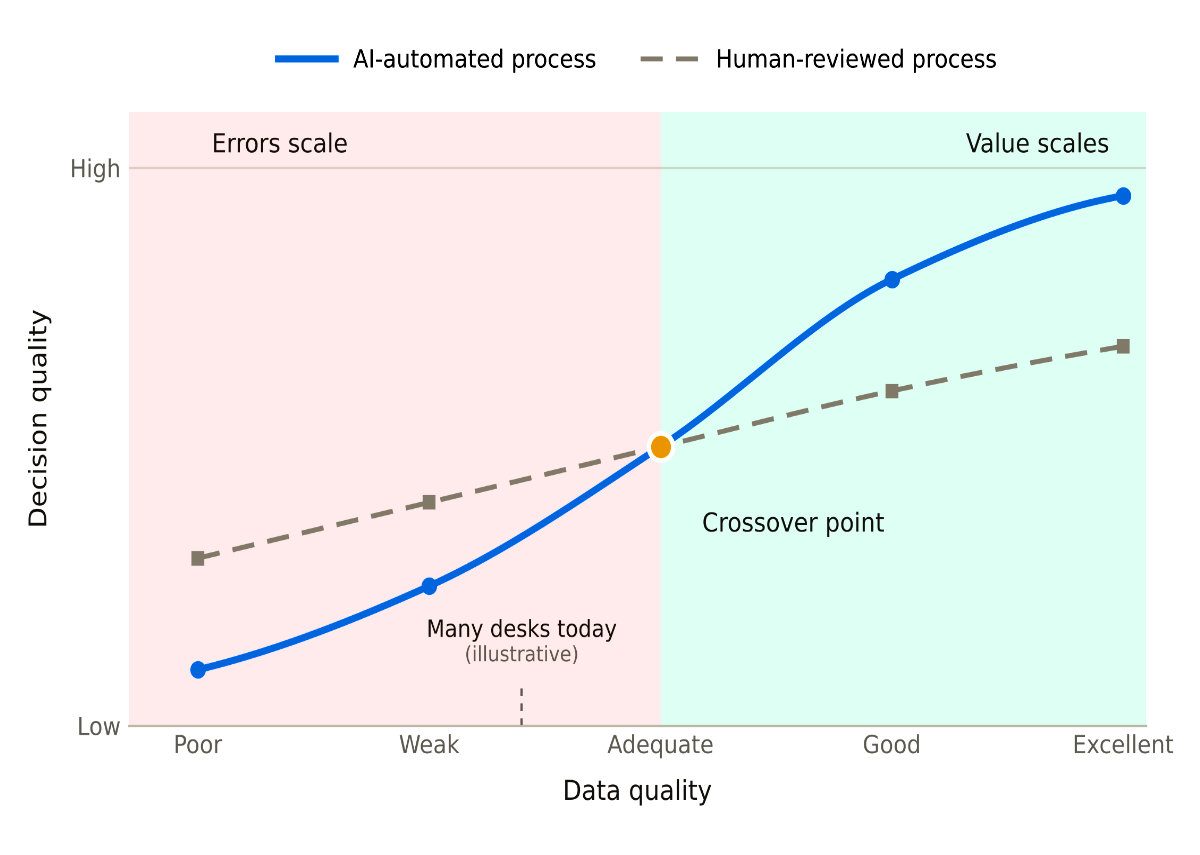
Figure 1. Below an adequate level of data quality, automation scales errors faster than people can catch them. Above it, the same automation scales value. The competitive edge goes to the firm with the best-governed data rather than the best model.
Illustrative model, not empirical data. Data quality = provenance, timeliness, completeness and consistency. The “many desks today” marker is the author’s placement, not a sourced finding.
The evolution of electronic trading in FI means there is an ever-increasing data exhaust, driven by algo and portfolio trading. This exhaust is then siloed across multiple dealers and venues. TRACE in the US, Consolidated Tapes in the EU and UK are a structural fix, however that is only part of the solution. Market participants need to increasingly view standardised pre-trade, post-trade and reference data as a route to competitive advantage, especially with AI adoption, not merely a compliance factor.
To take a pro-active stance on data quality, sell-side and buy-side can implement solutions, often utilising AI. An obvious example is a quality “checklist” on data going into AI models, covering provenance, timeliness, completeness, consistency across sources and, crucially for compliance, ownership and usage restrictions. This checklist can be produced and monitored by AI agents, again with human overlay.
To emphasise, and those that know the work we did at Neptune should not be surprised, data quality is crucial and only becoming more so in an AI first world. AI scales outcomes in ways that humans can hardly comprehend, high-quality data ensures these outcomes are good ones. The worst outcomes are that traders, portfolio managers act on erroneous model outputs due to poor data or, they abandon aspects of AI due to a lack of confidence in these outputs and lose the competitive battle. To answer the title, as you already know, garbage in does not equal alpha!
©Markets Media Europe 2026