



For most of their short life, credit index futures were a market built one small clip at a time. Useful for hedging a book at the margins, maybe, but not a venue where a portfolio manager would try to move real size without expecting to pay for the privilege. That has changed.
Across Cboe’s iBoxx Credit Index Futures complex, which spans IBHY in high yield, IBIG in investment grade and IEMD in emerging markets, block trading has grown from an occasional print into a routine part of how the market clears size, and two months running of data now back that up.
Monthly block counts across IBHY and IBIG have moved from low single digits in early 2024 to double digits through most of 2026, with recent months reaching into the mid-teens. In August, IBIG alone posted the highest single-month block count of the three contracts, a sign that investment grade has caught up to, and in count terms briefly passed, the high yield contract that had led block activity for most of the market’s history.
The dollar figures tell the same story with more precision than before. In August, block trades in IBHY totalled roughly $1 billion in notional against $2 billion traded electronically, meaning blocks accounted for close to a third of the contract’s active volume. IBIG ran a similar split, with $557 million in blocks against $888 million electronic, putting block activity at just under 40 percent of the total. IEMD looked different: only $3 million traded in block form against $81 million electronic, well under 5 percent, consistent with a market still earlier in its development. IBHY’s roughly $1 billion block total in August followed a similar figure in July, which suggests the market’s first billion-dollar block month was not a one-off spike but the new normal for the contract.
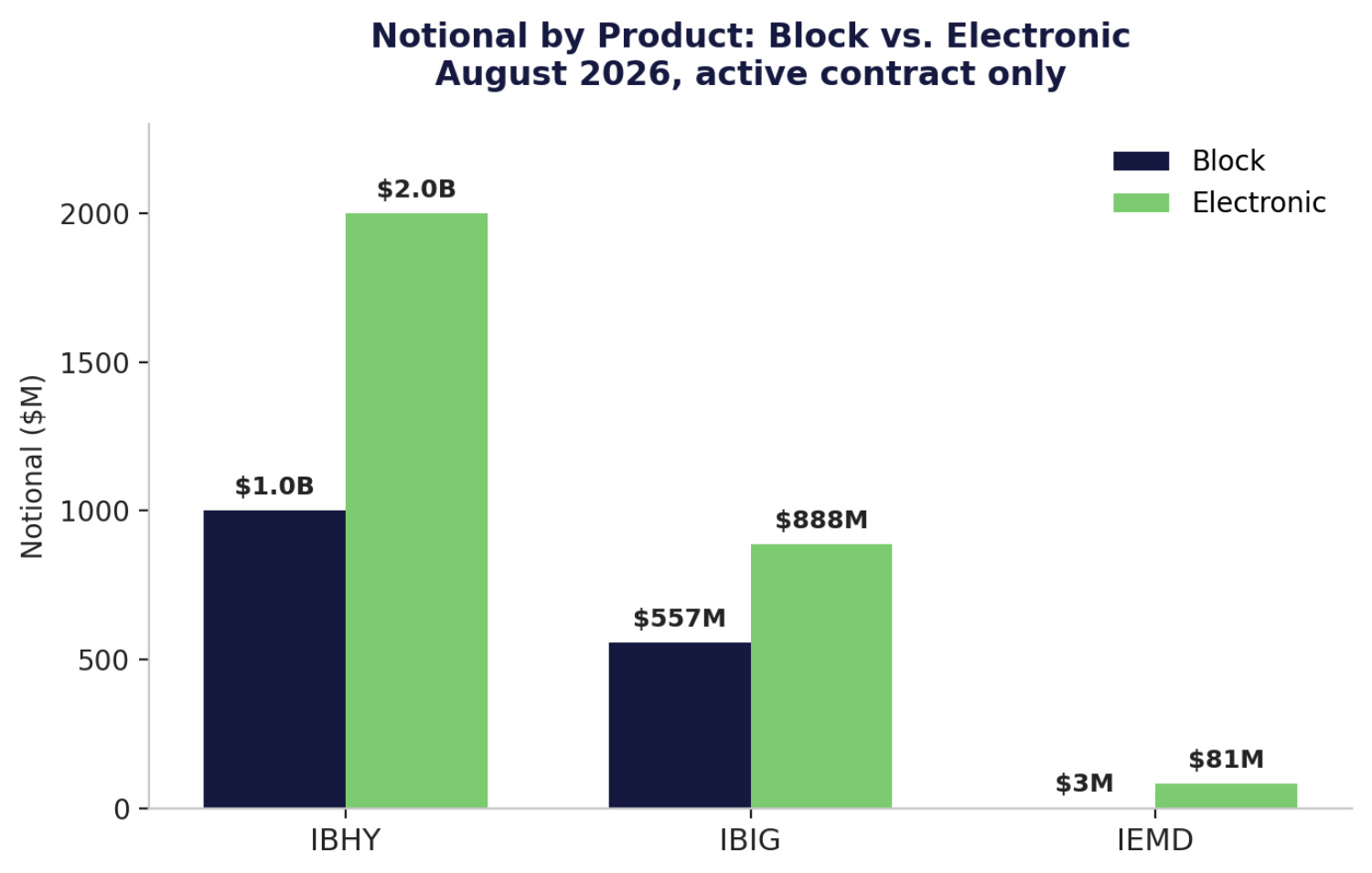
Notional by product: block vs. electronic, August 2026 (Cboe Global Markets)
Block facilitation exists in futures markets for a specific reason: it lets a participant negotiate a large trade away from the visible order book, above an exchange-set minimum size, and have it reported and cleared through the same mechanism as any other trade on the contract. A market only develops meaningful block activity once enough participants trust that the mechanism works and that counterparties exist on the other side of size. That trust does not build quickly, and its arrival in credit index futures says something about who is now using the product and why.
The users driving that shift are not, for the most part, traders looking to express a short-term view. They are portfolio managers and hedgers sizing a trade to the risk they are actually carrying, whether that means offsetting a bond allocation, adjusting duration and credit exposure separately, or replacing a funded position with one that ties up a fraction of the capital. Some are running credit futures alongside Treasury futures and CDS as part of a broader relative value book, using each instrument for what it does best rather than treating them as substitutes. Insurers and pension funds evaluating listed credit derivatives for the first time tend to care most about exactly this kind of capital efficiency, and a market that can absorb their size without moving against them is a precondition for using it at all.
The split between IBHY and IBIG’s block character and IEMD’s almost entirely electronic profile is itself a useful signal. It suggests block liquidity develops in a predictable order, following open interest and overall market depth rather than arriving everywhere at once. IEMD’s open interest has grown steadily since 2024 without yet reaching the scale of its high-yield and investment-grade counterparts, and its execution mix looks exactly like what an earlier-stage market should look like.
For more information on Cboe’s iBoxx Credit Index Futures, visit cboe.com/credit-suite or contact ListedFixedIncome@cboe.com.

Data: Cboe Global Markets, August 2026
©Markets Media Europe 2026