


When differences between riskier borrowers become paramount, picking winners and losers in credit matters more than ever.
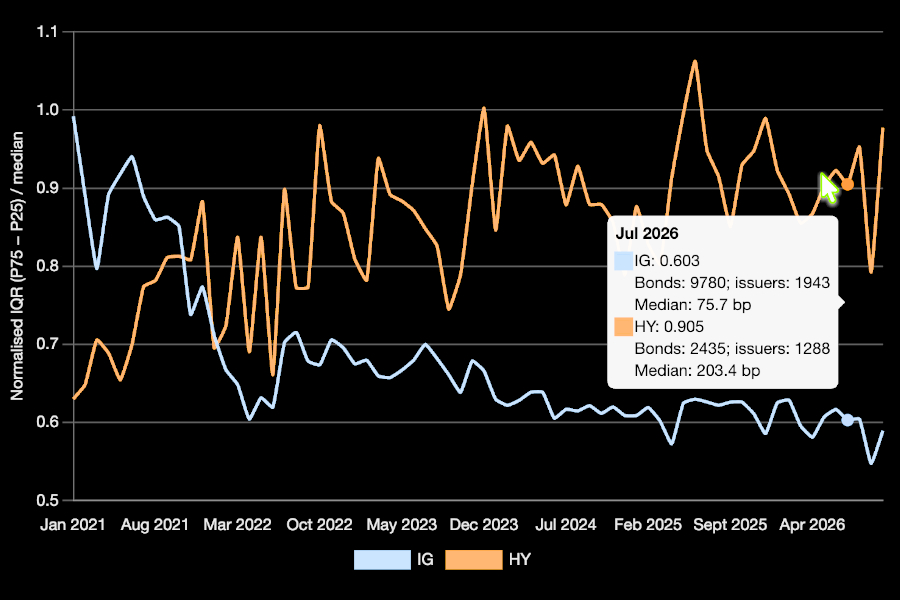
Corporate credit markets are showing some of their sharpest divisions in nearly six years, with high-yield spread dispersion approaching historical highs even as investment-grade bonds continue to trade within comparatively narrow ranges, according to new analysis of S&P Global iBoxx data.
Amid reports that some credit funds are struggling with distressed debt positions, the divergence reinforces warnings from asset managers at FILS Europe last month that tight average credit spreads are concealing increasingly different prospects for stronger and weaker borrowers.
“Please don’t look at averages,” said Olivier de Larouzière, global head of fixed income at BNP Paribas Asset Management, which manages more than €1.7 trillion.
Data compiled by Risky Finance from 70 monthly iBoxx corporate bond snapshots shows that normalised high-yield spread dispersion reached 0.977 in both USD and EUR markets in October 2026, the seventh- and sixth-highest readings respectively since January 2021.
By contrast, investment-grade dispersion remained close to historical lows, at 0.589 in USD and 0.452 in EUR. In euro credit, high-yield dispersion was 2.16 times that of investment grade, the widest gap in the available history.
Corporate bond credit-spread dispersion
Monthly bond-level option-adjusted credit spreads
Loading credit-spread data…


The divide between stronger and weaker high-yield borrowers is even more pronounced.
The median option-adjusted spread differential between CCC and BB bonds reached 677 basis points in USD, an increase of 260bp over the past year, while the equivalent EUR differential reached 1,065bp, up 68bp.
Including bonds rated below CCC, the EUR differential reached 1,195bp, the highest in the 70-month series.
De Larouzière warned that differences between ratings and sectors were becoming particularly pronounced in high yield, where distressed borrowers faced a much greater cost of capital.
“Dispersion between let’s say double Bs and triple Cs is at the record high level,” he said, highlighting the contrast between resilient issuers and companies exposed to economic weakness.
CCC versus BB: the credit-risk divide
Monthly bond-level option-adjusted credit spreads
Loading credit-spread data…
Nachu Chockalingam, head of London credit at Federated Hermes, which manages $884 billion, argued that the credit market was moving away from the period when broad market direction and central bank policy dominated investment returns.
“Dispersion has to become more of a priority and more of a focus,” she said.
Chockalingam highlighted refinancing risks in 2028 and 2029, when highly leveraged companies that borrowed at low coupons could face dramatically higher interest costs, potentially against a backdrop of weaker economic growth.
She warned that some high-yield borrowers could have to refinance at twice their previous coupons, with technology, media and telecommunications among the sectors facing particular pressure.
James Turner, head of active fixed income for EMEA at BlackRock, with total AUM of $15.5 trillion, also highlighted the potential for artificial intelligence to create winners and losers in credit.
Companies benefiting from AI could attract capital and refinance more easily, while highly leveraged borrowers threatened by technological disruption could struggle.
“Active credit selection has always been important, but I think it’s going to be more important than ever,” he said.
However, Maya El Khoury, senior credit portfolio manager at Ostrum Asset Management, which manages €393 billion, challenged the suggestion that refinancing pressures would become widespread among higher-rated European high-yield issuers.
“I really disagree that there’s a refinancing wall for double Bs,” she said.
El Khoury argued that the European high-yield market had sufficient normal issuance capacity to absorb forthcoming maturities, with many companies already having refinanced their debts.
She suggested that private credit could prove more vulnerable, particularly where weaker borrowers had benefited from abundant liquidity and loose financing conditions.
The contrast between these views illustrates the implications of growing credit dispersion. While stronger companies may continue to refinance on attractive terms, weaker issuers could face significantly higher borrowing costs, restructuring pressure and limited access to capital.
For investors, the challenge is increasingly to distinguish between the two rather than relying on broad credit spreads as a measure of risk.
©Markets Media Europe 2026