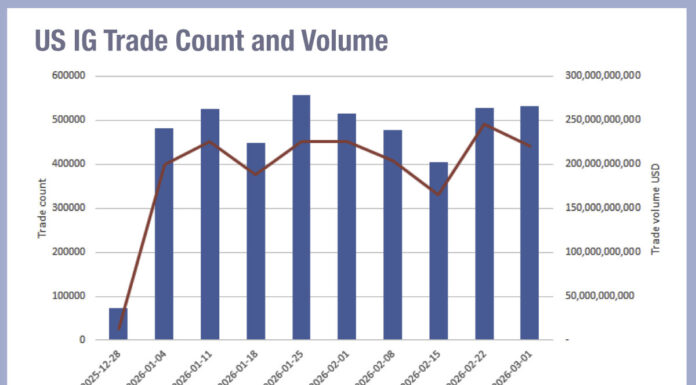




The new post-trade transparency regime was introduced 1 December 2025 in the UK and 2 March 2026 in the EU. A FIX EMEA Trading panel debated how the transparency uplift has been markedly stronger in the UK and what the future impact of the new regime will be, from reporting domicile gaming to potential credit aggregated order books.
Panellists at FIX EMEA gave conference attendees their first read of the new market transparency regime impact. Albeit with only a few days of data for the European regime, UK reporting is the one ongoing a far more drastic change.
 Analytics provided by Propellant Digital
Data presented by Propellant Digital at FIX EMEA Trading showed total real-time transaction reporting increased by 122% in the EU against 307% in the UK under the new regime, while reported notional rose 114% in the EU and 336% in the UK. The UK therefore remains smaller overall but is driving the sharper step-change in post-trade visibility.
That pattern was visible across several major fixed income buckets. In European government bonds, transaction reporting rose 102% in the EU against 236% in the UK, while reported notional increased 109% versus 270%. In USD corporate bonds, the uplift was far more pronounced, with transaction growth of 636% in the EU against 2,478% in the UK, and notional growth of 372% against 1,431%.
The standout category was sterling corporate bonds, where transaction reporting rose 1,488% in the EU but 14,148% in the UK. Reported notional increased in the UK. As discussed on the panel, that reflects in part how little of that market had previously been visible in real time, rather than an equivalent jump in underlying trading activity.

Vincent Grandjean, CEO of Propellant Digital, said sterling credit had gone from roughly a few dozen trades over months to around a thousand trades in the new reporting window, underlining how opaque the market had been before.
While the data also showed that each tape remains strongly domestic in core products with EGB reporting still overwhelmingly EU-based, and gilts and sterling credit remain heavily UK-led, in dollar products the UK has a larger role. It accounted for 56% of US Treasury trade reports and 64% of reported notional, suggesting larger average ticket sizes, while USD corporate bonds came in at 65% of transaction count and 68% of notional.
The largest changes observed were in emerging credit reporting on both sides of the channel. While from a low base, notional and trade count reported jumped by four-digit percentages. For example, Asian quasi sovereign credit number of trades jumped 7903% in the UK, while in the EU, Middle East quasi-sovereign notional traded jumped 14000 %.
Panellists also said it was still too early to conclude whether transparency had materially changed trading behaviour. For now, they agreed that a lot of traders do not yet use all this new available data. One speaker said the effect would take time because the key issue is whether the data is then plugged into trading workflows and analytics, while another recognised the immediate benefit pf simply knowing that something had traded.
Still, the panel also pointed to more structural implications. Participants discussed the risk of jurisdictional or reporting-domicile gaming, as firms weigh whether trades are processed under UK or EU transparency rules, especially where deferral windows differ sharply. Market participants agreed that in time they expect regulators would align reporting delays to stop such gaming happening.
Panellists argued the extra data could gradually support more aggregated liquidity views in credit, even if a true order book remains unlikely. One trader said the more realistic future model would be an aggregated, tagged, two-sided click-to-trade liquidity, rather than an equity-style central book.
This would echo current regulatory concerns about market venue perimeters.
Read more: Regulators start patrolling trading venue perimeter
For now, the EU is larger on total notional reported, with 64% of reported size against 36% for the UK. But the new regime’s early impact has been markedly stronger in the UK.
©Markets Media Europe 2025