




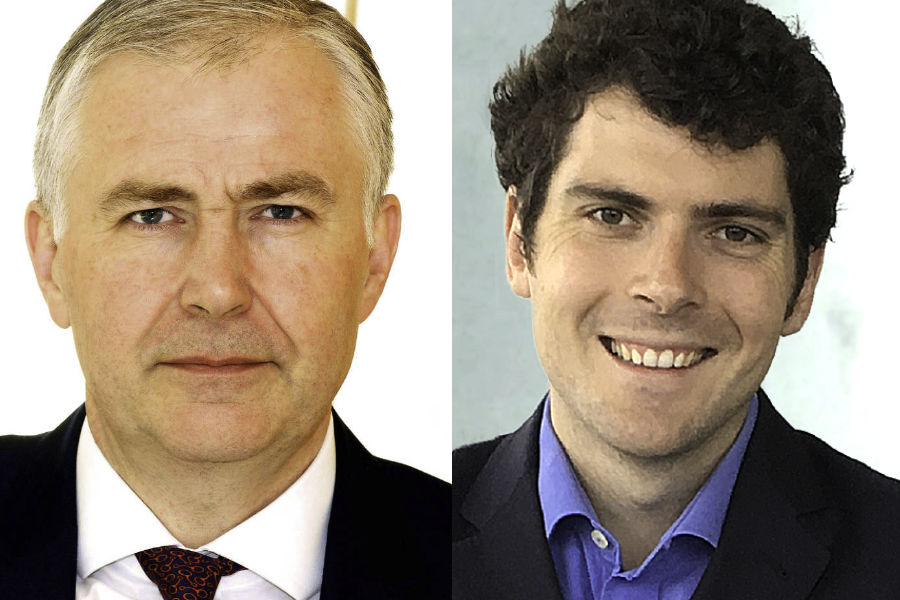
More than a year after closing its acquisition of AXA IM, BNP Paribas Asset Management has now reached the stage of trading desk integration. Two senior members of the trading team spoke exclusively to The DESK.
From an outside perspective, the acquisition of AXA Investment Managers appeared to end in July 2025 when the merger was officially completed, and AXA IM was folded into BNP Paribas’ Insurance & Protection Services (IPS) division, creating a €1.7 trillion buyside giant.
Read more: No Danish Compromise for BNP Paribas – The DESK – The leading source of information for bond traders
However, for the teams of traders within each legacy firm, the work was only beginning. According to a BNP Paribas presentation in March 2026, €1.15 trillion in AUM for the combined operation was in active funds and ETFs, and €350 million in alternatives. The largest single segment is fixed income with 35% of combined AUM, which is what outsiders might assume to be the toughest part to integrate.
Despite intense curiosity from the fixed income trading community, BNPP AM declines to comment on vendor partnerships, such as reports that it will drop AXA IM’s legacy SimCorp order management system in favour of the Blackrock Aladdin OMS currently used by BNPP AM. However, there is a lot it is now willing to share.

Benjamin Mahe and Lee Sanders from the fixed income trading team at BNP Paribas Asset Management spoke exclusively to the DESK about their experiences so far. Mahe said, “We are currently in the process of merging two trading hubs into a unified execution platform. This is an extremely exciting project because each legacy entity has developed numerous functionalities tailored to their specific needs and constraints. For example, the ex-AXA IM structure was deeply rooted in servicing insurers and possessed many tools that will be kept and benefit the combined entity. On the other side, for instance, the legacy BNPP AM trading team focused heavily on automation and no touch processes – which will also be a key value driver in the integrated platform.
To date, we have already converged many processes and procedures, such as our best selection and execution framework, and we continue to make considerable progress. This integration leverages the strengths of all teams involved, making it a very promising project to watch.”

According to Sanders “When two firms merge, progress can feel slow, but when you step back and reflect, you realize how much has already been achieved. In the new setup, we will have access to cutting-edge technology — something everyone recognises as a major benefit.”
For Mahe, the devil is now in the details. “While we are converging, we also need to continue innovate. For instance, one big topic for the industry is how to manage and streamline the process for Fixed Income New Issues. The Primary Market is still very manual and has remained in the stone age while all the rest of fixed income execution has mostly become electronic. There are different approaches to tackling this and we continue our journey with other stakeholders such as platforms, to digitalise this workflow as much as we can.”
Derivatives are another topic to think about. “There are differences in how we handle certain derivatives, as the two legacy systems employed different workflows. In the target setup, we are integrating the best elements from both, to create a cohesive and efficient system. When a trade is bilateral, the counterparty needs to review the CSA, compute XVA, look at risk limits etc., and these parameters are typically not fully integrated into the electronic execution workflows between the liquidity providers and the platforms, even for the most vanilla OTCs. We are collaborating with different stakeholders to have the ability going forward to execute most of it electronically.”
For fixed income fund managers, there is an ongoing debate about using separate trading desks, when portfolio managers may have their own liquidity insights and prefer to execute bond trades directly in the market. But Sanders is passionate about the need for separate buyside trading desks.
According to Sanders, “In our firm, due to our focus on institutional clients, having a dedicated trading desk proves to be far more effective. Traders develop expertise in specific markets, and their primary goal each day is to secure the best possible prices for trades. This yields many benefits, and concrete evidence of the effectiveness of this setup is reflected in improved Transaction Cost Analysis (TCA). I regularly look at reports and conduct analysis comparing our execution results against external benchmarks and market bid-offer spreads for our steering committees.”
Mahe continues “Beyond TCA, we also have comprehensive reports to manage our relationship with liquidity providers, we look at quality of axes, quality of service, normalised hit ratios, etc. To simplify, imagine I constantly put three firms in competition through RFQs. Ideally, each firm would win about 33% of the trades. If one wins 40%, and another only 20%, we will discuss with the underperformer—either they improve their pricing to remain competitive, or we bring in another liquidity provider.”
Mahe takes pride in the combined entity pioneering work on fixed income axes. “We were the first firm to develop a system capable of receiving axes directly from counterparties, which became a core part of our trading desk’s culture. Initially, this information was shared via Excel spreadsheets, but today it has been fully digitalised and automated. The axes data we receive from various sources is aggregated into a proprietary tool. This enables us, especially on large orders where we may go in non-competition, to identify and approach the most relevant counterparty right from the start.”
He also explains that the development of this internal liquidity portal will continue during the merger. “Both teams previously used proprietary systems, and we are now integrating the best features of each. This is a key part of our Fixed Income trading platform— enabling us, when we receive orders, to evaluate liquidity and assess pricing rapidly. If liquidity on a specific bond is not favourable or if the price is unattractive, we can provide feedback to the portfolio managers and sometimes recommend switching bonds, helping them make better-informed decisions.”
Regarding portfolio trades – Sanders notes that this now accounts for 20-40% of investment grade volume and that the market has become excessively competitive for sell-side firms. “Pricing on these trades has become so aggressive that we often print close to the mid or even better. We will observe whether this strategy is sustainable—but it clearly demonstrates their priority to stay relevant to their clients.”
Another important development is the bond consolidated tape. Mahe explains, “While increased market transparency seems beneficial, we initially feared that the consolidated tape could hinder big block trading. Real-time visibility might discourage liquidity providers from taking large risk positions. The calibration of the tape thresholds was extensively discussed, and we will remain very vigilant, for future evolutions, to assess whether we can maintain our ability to source sizeable blocks discreetly.”
Sanders explains how market practices have evolved. “In the UK, for example, the model has changed. Banks are recycling these blocks in a different way without necessarily sacrificing liquidity but simply handling it in a more subtle way.”
Mahe foresees increased automation in this space. “The tape is likely to drive more automated workflows, with new liquidity providers and skills emerging. Understanding how these platforms and data flows work is crucial.”
Yet, Sanders emphasises that voice trading will persist. “After 27 years on trading desks, I am convinced that the idea of completely replacing voice with automation is a myth. Market participants still value voice—particularly in bond trading, which remains predominantly voice-driven. The costs of brokerage on platforms and the importance of maintaining client relationships mean that a significant volume will continue to be traded by voice.”
Mahe remains attentive to broader industry shifts. “As AI continues to advance and all market participants become more sophisticated, we are likely to witness significant changes in market infrastructure, and certain players could gain substantial influence. With increasing competition from electronic liquidity providers, there’s potential for greater differentiation, but also an increased level of risk.”
©Markets Media Europe 2026