



For years, a credit portfolio manager looking to move size in high-yield or investment-grade risk had one real option: pick up the phone, negotiate a block trade in a swap or a CDS index away from public view, and hope it cleared before the size leaked into the market. Now there’s a listed product that can serve a similar purpose.
Block trades in Cboe’s credit index futures topped $1 billion in a single month for the second consecutive time in August, evidence that institutional investors are moving real size in IBHY (Cboe® iBoxx® iShares® $ High Yield Corporate Bond Index Futures); IBIG (Cboe® iBoxx® iShares® $ Investment Grade Corporate Bond Index Futures); and IEMD (Cboe® iBoxx® Emerging Markets Corporate Bond Index Futures), without the friction of a bilateral OTC trade. Despite the seemingly sudden attention on the products, the climb has been steady. Monthly block trade counts in IBHY futures and IBIG futures have moved from the low single digits in early 2024 to the double digits through most of 2026, with some months this year reaching the mid-teens. In August 2026, IBIG futures block trade activity overtook IBHY futures block trade activity for the first time, a notable shift given IBHY futures had led block activity for most of the market’s history.
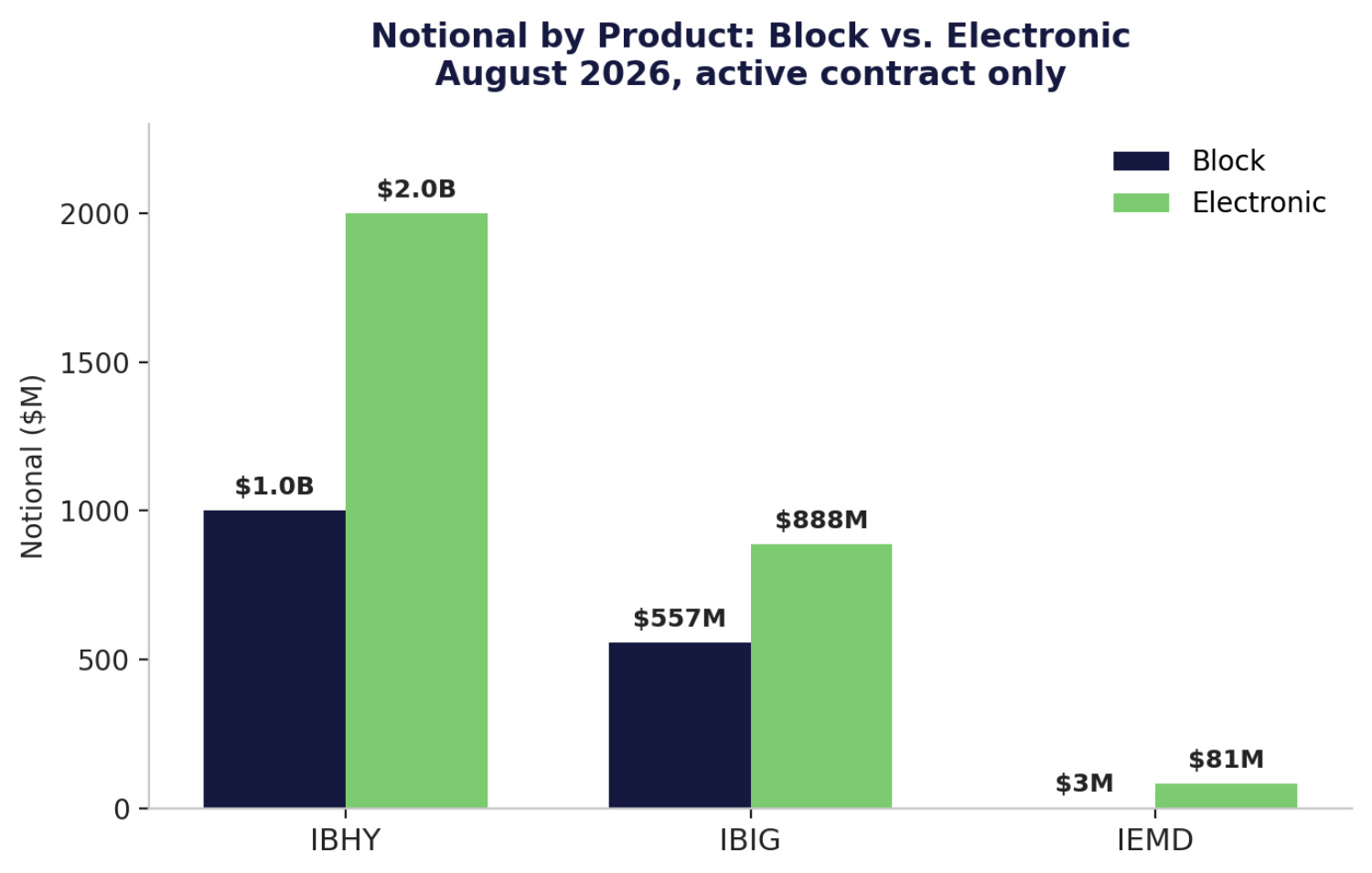
Block trades comprised nearly a third of the IBHY futures active volume in August 2026. Block trades totaled roughly $1 billion in notional against $2 billion traded electronically. This came after a similarly strong July, an early sign that block activity is may be building momentum. The IBIG futures split was similar: $557 million notional in blocks trades against $888 million in electronic trading notional volume, or just under 40% of the total.
Of course, block trading itself isn’t new; traders have negotiated size in CDS indices and total-return swaps away from the screen for years, agreeing on a price privately before sending it for clearing. Putting that process inside a listed futures contract instead of a bilateral swap line is what’s new, and the distinction matters. A block executed in IBHY futures or IBIG futures clears through the same mechanism as other products offered on an exchange. With this structure, the traded does not tie up an ISDA credit line, consume a dealer’s balance sheet or require negotiating a credit support annex with every counterparty on the other side. Despite the frictions of using the OTC market, use of that market by participants may have continued based on its familiarity and established practices. Moving OTC volume onto an exchange requires enough participants to have trust in the use of the block trade process and believe that a counterparty exists on the other side of a block trade. This summer’s block trade activity in IBHY, IBIG, and IEMD futures indicates that the market may have crossed that threshold.
The credit futures market has evolved to include a variety of strategies and perspectives executed by an array of participants, highlighting the many use cases for the products. Many investors in this market aren’t chasing a short-term view, but sizing trades as a potential tool to manage risk they’re already carrying – like offsetting a bond allocation, separating duration from credit exposure, or replacing a funded position with one that ties up less capital. Some are incorporating credit futures alongside Treasury futures and CDS as part of broader relative-value books, using each instrument for what it does best. For insurers and pension funds evaluating listed credit derivatives for the first time, that potential capital efficiency is often the deciding factor, and a market with the potential to absorb the size of the trades without moving against them is what makes participating possible in the first place.
Cboe’s Credit Index Futures are listed for trading on Cboe Futures Exchange, LLC. For more information on Cboe’s Credit Index Futures, visit cboe.com/credit-suite or contact ListedFixedIncome@cboe.com.

Data: Cboe Global Markets
Informational purposes only; not investment advice. For trading risk information, see the Risk Disclosure Statement Referenced in CFTC Letter 16-82 and the Risk Disclosure Statement for Security Futures Contracts, and visit Disclosures and Disclaimers Related to Cboe Products and Services | Cboe.
IBIG and IBHY, (“Products”) are, respectively, based on the Markit iBoxx USD Liquid Investment Grade Index and the Markit iBoxx USD Liquid High Yield Index (“Indexes”). The Indexes are property of S&P Dow Jones Indices LLC or its affiliates (“S&P”). iBoxx® is a registered trademark of S&P. iShares® is a registered trademark of BlackRock, Inc. or its affiliates (“BlackRock”). The Products are not sponsored, sold, endorsed, or promoted by S&P or BlackRock. BlackRock has no role in or liability for Index composition or data (including accuracy, completeness, or continuity), or the pricing, terms, administration, or trading of the Products. S&P and BlackRock disclaim all representations and warranties regarding the Products and Indexes – including as to trading advisability, Index tracking ability, results from Index data, merchantability, and fitness for any purpose – and all liability for damages of any kind, including lost profits (even if notified).
©Markets Media Europe 2026