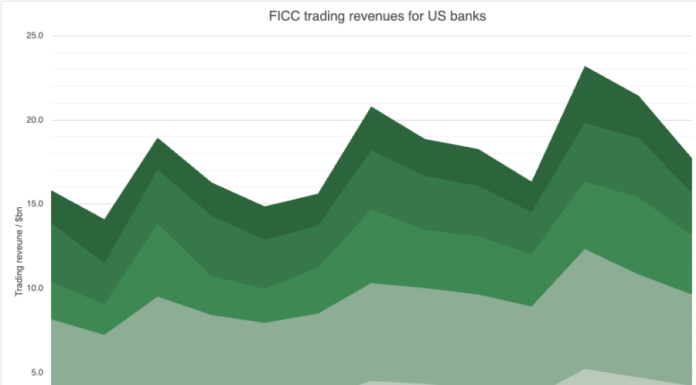


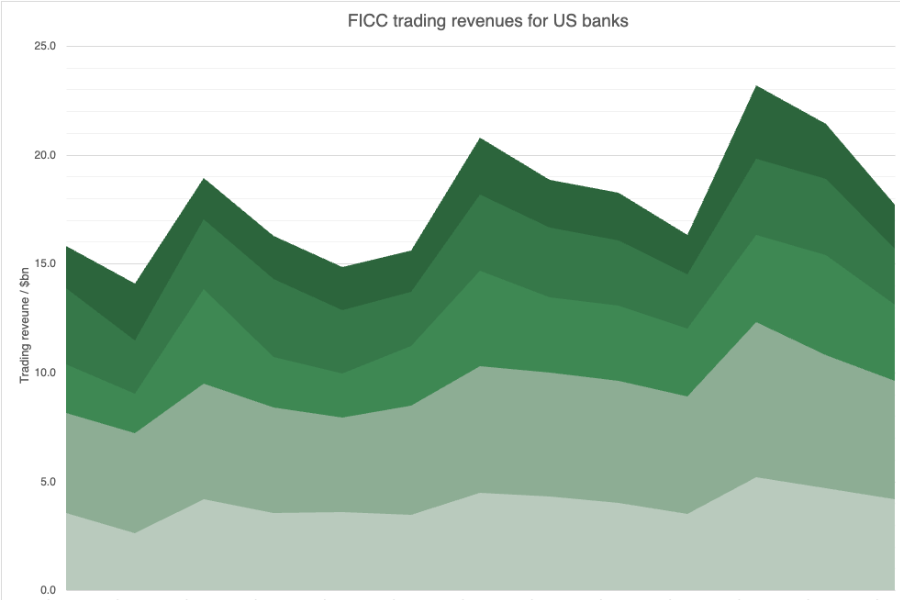
Fixed income trading revenues at US banks saw a yearly decline, with the top five players generating a combined US$17.7 billion.
This marks a 17% quarter-on-quarter (QoQ) and a 1.6% fall year-on-year (YoY).
JP Morgan is still firmly ahead of its competitors, despite revenues falling for the last two quarters. Revenues were down 11% QoQ and down 4% YoY.
Runner-up Citi saw fixed income revenue decline 11% QoQ and rise 5% YoY to US$4.2 billion.
“Rates was pressured by the trading environment, but we saw good growth in FX and spread products, both stable revenue streams,” said CEO Jane Fraser.
“Rates and currencies was flat, with growth in currencies and higher volumes offset by lower revenues in rates,” elaborated chief financial officer Gonzalo Luchetti.
“Clients know and trust us, particularly from the fixed income side,” Fraser added.
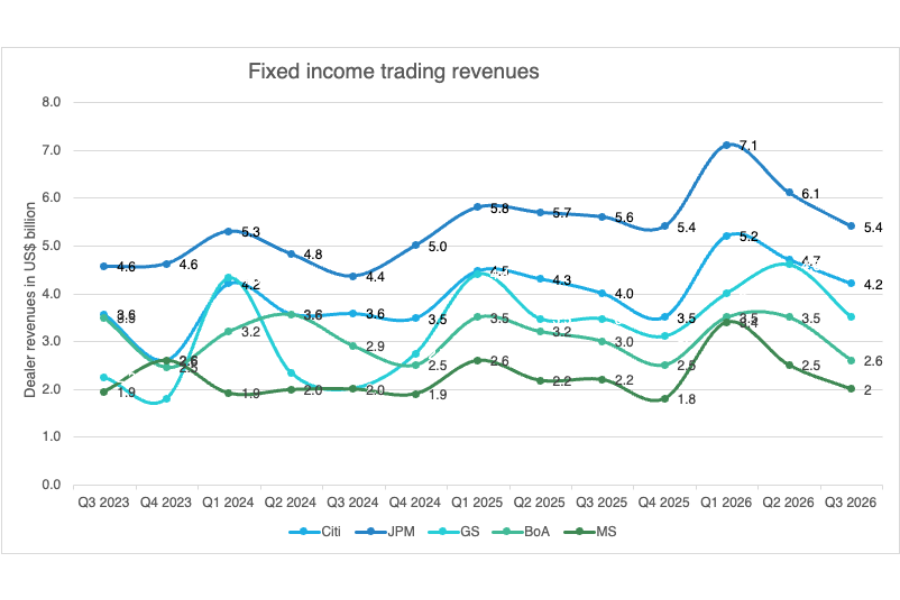
Goldman Sachs’ revenues fell after threatening Citi for second place last quarter, down 24% QoQ and up remaining static YoY at US$3.5 billion.
“We remain steadfast in supporting our clients’ global risk intermediation needs across asset classes amid sharp moves in rates and increased volatility in commodities,” said CEO David Solomon.
“Intermediation revenues declined 7%, as lower results in mortgages, rates, and credit were largely offset by strong performance in currencies and commodities.”
At Bank of America, revenues were down 26% QoQ and 13% YoY to US$2.6 billion.
Chief financial officer Alastair Borthwick stated that the bank is working to “fill the gaps” in its FICC franchise.
“We feel like we can continue to do more with clients around the world in rates and foreign exchange and commodities,” he said.
“We’ve got some pretty good growth opportunities in those areas. We continue to invest there, and you should expect to see us continue to grow.”
Morgan Stanley is stuck at the bottom of the league table, but saw revenues fall less steeply than some of its peers. Its US$2 billion in fixed income trading revenues for Q3 marked a decline of 20% QoQ and 9% YoY.
According to chief financial officer Sharon Yeshaya, this was the result of lower structured activity in credit and commodities.
“There was a time when fixed income was an Achilles heel of the Morgan Stanley investment bank dating back 15 years,” said CEO Ted Pick.
“There was a time when we wanted to get to US$1 billion a quarter. Now, the business is integrated with investment banking and capital markets on the private side and equities in a way that this institution has never seen, which is an extraordinary thing.”
Hyperscaler financing
As expectations for hyperscaler funding requirements continue to balloon, markets are questioning whether the AI party is sustainable.
Financing revenues were up 14% at Goldman Sachs in Q3, driven by mortgages and structured finance.
“Recent studies estimate that the US data center build-out could require north of $10 trillion in investment through 2032, averaging roughly 3.6% of US GDP annually,” stated Solomon.
“In our conversations with clients, demand for compute significantly exceeds supply at the moment, creating opportunities to help develop financing structures to meet that capacity shortfall.”
“While we are proud of the privileged position we play in the AI investment cycle, no one knows how the demands for capital and compute will evolve as the broader AI ecosystem matures. This uncertainty reinforces the importance of remaining vigilant around the types of activity we finance and how we manage risk as we support our clients.”
JP Morgan was also was questioned on the sustainability of hyperscaler funding.
“An important question is our appetite for future exposure in light of the announced amount of capex that needs to happen in this ecosystem and the associated demands or requirements from the financial system,” said chief financial officer Jeremy Barnum.
“Single issuer concentration is something that’s going to get managed, and given the nature of these structures you have to be sophisticated about assessing your direct and indirect exposure. There’s a lot of nuanced credit analysis that needs to be done to correctly assess your individual issuer exposure across the ecosystem.”
Elsewhere, Citi’s Luchetti noted an increase in spread products financing revenues, pushing up the bank’s ‘spread products and other fixed income’ division up 13%.
©Markets Media Europe 2026