






Corporate bond traders should be well-prepared for sudden shocks in 2026, by broadening their access to solid pre-trade information, low-friction paths to liquidity and by building experience in which counterparties can support different trading protocols, to optimise execution outcomes.
Traders are navigating a complex landscape in 2026, characterised by historically tight credit spreads, heightened policy uncertainty and surging issuance volumes. Morgan Stanley analysts reported that in the final week of January, US investment grade (IG) spreads reached new tights of 71 basis points (bps) mid-week, the tightest since 1998, before ending the week 1bp wider.
Song Jin Lee, European & US credit strategist at HSBC, writes, “Global corporate bonds have had a strong start to the year, shaking off geopolitical tension, renewed trade tensions, and fiscal concerns. Market confidence in the growth outlook and AI cycle plays a key role, but we think investors should not take that for granted. With spreads at multi-decade tights, it pays to seek diversification strategies that guard against risks to consensus expectations.”
The Federal Reserve’s interest rate trajectory remains uncertain, with analyst expectations for one or two additional cuts in 2026 after three reductions in 2025.
The nomination of Kevin Warsh for Federal Reserve governor has not materially affected the outlook on cuts for many analysts; for example, Morgan Stanley notes there may be a limited scope for a “near-term shift in the Federal Open Market Committee (FOMC) rate reaction function; any meaningful changes under a Warsh Fed are more likely to emerge gradually via balance sheet policy rather than interest rates.”
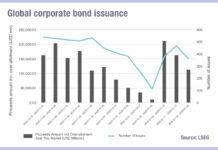
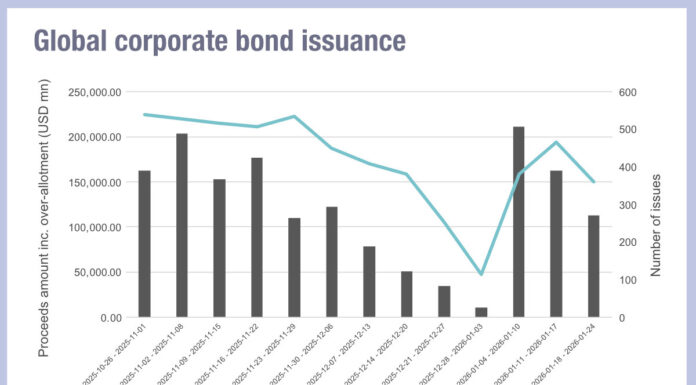
Meanwhile, global issuance is decelerating, with projections by S&P Global indicating that it will grow by 4.8% in 2026, slowing from nearly 11% last year.
“As of 1 January 2026, roughly $10.2 trillion in corporate debt was coming due between 2026 and 2029, up 5.6% over the 2025-2028 total” write S&P Global analysts Nick Kraemer, Luca Rossi and Zev Gurwitz. “These totals should support modest growth in bond issuance this year, particularly when combined with the potential for increased M&A and associated debt funding, continued economic growth, relative dollar stability, and corporate earnings growth.”
Technology companies are leading this charge, issuing substantial levels of debt in order to finance artificial intelligence infrastructure buildouts, while utilities and other sectors also contribute to elevated supply levels.
While the fundamental health of corporate borrowers appears solid, with strong balance sheets and manageable debt maturity schedules supporting current valuations, historically low credit spreads leave little room for error on valuations and should economic growth slow more than anticipated or if defaults begin climbing from current subdued levels, spreads could widen rapidly, triggering price volatility across corporate bond portfolios.
Investor confidence has been most publicly uncertain around the projections for financing of AI infrastructure, and tech firms such as Oracle have responded to those concerns by balancing financing across equity and fixed income instruments.
Geopolitical factors add another layer of uncertainty to 2026 trading conditions. Tariff policies, questions surrounding Federal Reserve independence, and US fiscal deficits all contribute to an unpredictable environment that could spark sudden market reactions. Recent episodes of global bond market volatility, including dramatic spikes in Japanese government bond yields, demonstrate how quickly sentiment can shift in interconnected markets.
For institutional traders, this environment can favour active management and hyper-vigilant trading rather than passive strategies. The potential for policy-driven market disruptions means that traditional buy-and-hold approaches may face greater risks than normal. Volatility will create both risks and tactical opportunities for nimble traders.
©Markets Media Europe 2025