




Listen here
In a crowded electronic market, the harder questions concern liquidity, economics, and who ultimately pays for access.
That was the question I posed recently when asking market participants for their views on the latest entrants into electronic fixed income trading. It is deliberately provocative, because the answer is not really about counting platforms.
The landscape remains fragmented, yet this summer also brought a significant change in ownership, with ICE agreeing to acquire MarketAxess in a transaction valuing the business at approximately $5.7 billion on an enterprise-value basis. The proposed combination is revealing in its own right: ICE is adding MarketAxess’s institutional trading network to its existing fixed income franchise spanning execution, data, analytics, indices, retail, and wealth channels. That does not necessarily imply consolidation of the underlying venues, which today serve different client segments.
A related question is how many RFQ platforms are actually out there? ICMA, maps some participants in its Electronic Trading FinTech Directory, although the directory is not exhaustive. John Greenan at Alignment Systems tried to take the bull by the horns, maintaining an updated list for over a decade. At last count the number was well over 150. The real answer to the question, however, is nobody knows.
Despite the heady numbers, new entrants continue to appear. They are not entering because fixed income is easy, but because they believe some part of the existing process can still be improved, whether through liquidity discovery, execution, data, workflow, or economics. Fixed income remains a magnet for innovation.
The established ecosystem is already formidable, although even the largest platforms are better understood product by product than as single, homogeneous businesses. Bloomberg, Tradeweb, and MarketAxess span multiple parts of fixed income, but government bonds, corporate credit, interest-rate swaps, repos, CDS, municipals, ETFs, and mortgages each have different liquidity characteristics, participants, and trading workflows. A platform can therefore be deeply established in one market while facing quite different competition in another.
The competitive set therefore changes depending on where one looks. In government and corporate bonds, firms such as CanDeal and Yieldbroker, now owned by Tradeweb, sit alongside the larger global venues; interest-rate derivatives bring in platforms such as OTCX and MTS BondVision; repo includes specialists such as GLMX and BrokerTec Quote; US retail and wealth-oriented fixed income includes Tradeweb’s retail offering, ICE TMC, and ICE BondPoint; while syndicated loans bring in specialists such as Octaura. Trumid, meanwhile, remains an important specialist competitor in credit.
New competitors continue to test that structure, although they are not all attacking the same part of the execution process. Some are refining established protocols, while others are looking for different ways to identify, access, and engage liquidity. The more interesting question is not whether another platform can enter the market, but what specific economic, workflow, or execution problem it is trying to solve.
Nor does a new entrant necessarily mean a start-up. Established platforms tend to develop their franchises asset class by asset class, adding protocols and products that deepen the client relationship and make the overall offering harder to displace. That also complicates how we define the competitive field. A platform may be deeply established in one part of fixed income while comparatively weak, or even absent, in another, and integrating a new protocol into a client workflow can take months rather than being a plug-and-play exercise.
Competition can also arrive from outside fixed income. FXSpotStream provides a recent example with the launch of RateStream. The relevant universe therefore extends beyond incumbent bond venues and fixed income start-ups to established firms in adjacent markets that believe their technology, connectivity, or commercial model can travel across asset classes.
Following the liquidity
A buy-side trader looking to execute an order rarely begins with the abstract question of which venue to use. The more immediate consideration is where the most credible liquidity is likely to be found, how much information should be disclosed while looking for it, and which method is appropriate for the order in question.
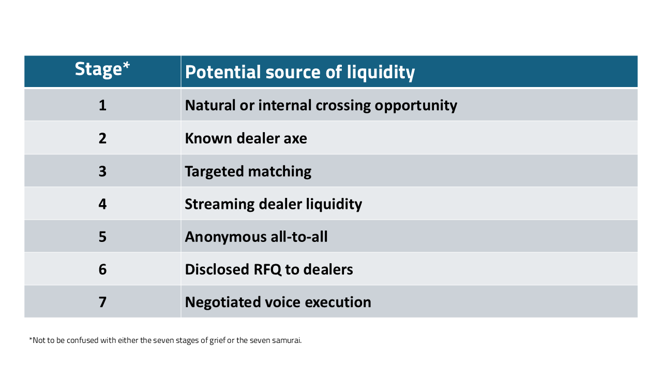
This is not intended as a rigid sequence. A liquid government bond may move immediately into streaming prices or RFQ, while a large position in a less liquid credit may begin with known dealer interest, a targeted counterparty, or a telephone call. Asset class, size, market conditions, and information sensitivity all affect the route.
The point is that electronic platforms compete for a position within a wider process of liquidity discovery. An entrant does not necessarily need to replace RFQ to create value. It might identify natural opposing interest earlier, improve dealer selection, reduce information leakage, aggregate fragmented liquidity, or make it easier for a buy-side trader to move between execution methods.
RealQ, the TP ICAP platform bringing together Liquidnet Fixed Income and Neptune Networks, provides an example through AxeMatch™,due to launch later this year. The disclosed bilateral workflow will connect dealer axes with relevant buy-side interest without broadcasting the inquiry more widely, narrowing the interaction to counterparties with a credible reason to trade and potentially reducing information leakage in larger or more sensitive orders.
In the US, Broadridge’s LTX combines the traditional RFQ capabilities familiar to institutional users with a different form of optimization through RFQ+ and the agentic capabilities in BondGPT. The emphasis is not on replacing the existing RFQ workflow, but on making it more efficient by helping the buy-side trader identify opportunities, select counterparties, and initiate parts of the execution process within trader-defined parameters, while retaining oversight and control.
AI will not replace the judgment of a good trader. Rather, AI can help that trader become even more effective by reducing the friction between finding trading opportunities and acting upon them. BondGPT incorporates AI within traders’ existing RFQ workflow, so they can discover and react to more opportunities, more quickly.
Jim Kwiatkowski, CEO, LTX
Every additional route to liquidity, however, has an economic cost. The way those costs are distributed across electronic fixed income is considerably less straightforward than the execution screen might suggest.

The price of a supposedly free market
For many European buy-side traders, electronic bond execution appears to be free. They send an RFQ to dealers, receive competing prices, and execute without subsequently receiving a transaction invoice from the venue.
The explicit transaction fee is often charged to the dealer providing the liquidity instead. That distinction has helped shape the economics of global electronic fixed income, while making the true cost of execution considerably harder for the buy-side to see.
There is no universal tariff applying to every dealer and every trade. Charges can depend on product, maturity, notional amount, protocol, aggregate volume, and the commercial arrangement negotiated between the platform and participant. Published fee schedules may provide a starting point, but they do not necessarily reveal what a large market maker ultimately pays on the marginal trade
For dealers without the systems needed to calculate these costs dynamically, the exercise can resemble a particularly unpleasant game of Tetris. Instead of the classic NES version, where the blocks arrive one at a time, imagine that they all appear at once: transaction charges, minimum commitments, volume tiers, subscriptions, negotiated discounts, and different protocol economics. The dealer then has to fit them together quickly enough to understand the real marginal cost of the trade without inadvertently pricing itself out of the market.
Some of the structures discussed by market participants can be summarized approximately as follows:
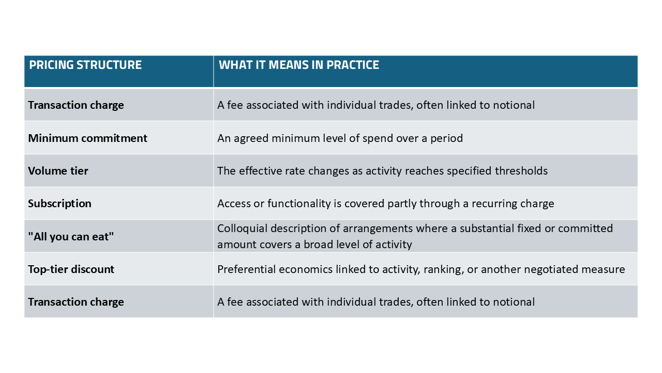
Several of these elements can operate simultaneously, making apparently simple comparisons difficult. A dealer may understand its own commercial arrangement in considerable detail while having little visibility into the effective rate paid by another market maker executing an otherwise similar transaction.
There is also a timing issue in the economics. Bid-offer spreads in more liquid bonds have compressed considerably, while venue charges have not necessarily moved at the same pace. A transaction fee that once consumed a relatively small portion of the available spread can therefore represent a much larger share of the economics today.
New trading platforms are emerging for a simple reason: execution cost and information leakage. With bid-offer spreads steadily tightening, legacy execution fees consume far too much of the spread. Desks need cheaper execution, paired with protocols that protect them from information leakage when trading size. New solutions are simply stepping into those gaps.
Senior fixed income executive at a global bank
That matters because venue fees form part of the economics of providing liquidity.
If the available bid-offer on a bond is 10 cents and the effective venue cost associated with winning the trade is 5 cents, a substantial part of the apparent spread has disappeared before the dealer considers inventory risk, hedging, capital, or balance-sheet consumption.
Senior market participant
The actual numbers will vary considerably by venue, participant, and instrument, but the principle is straightforward. A dealer can incorporate costs into the price shown to the client, favor a venue with more attractive economics, or become less competitive where transaction costs are large relative to the spread available.
This also explains why headline comparisons between venues can be misleading. The economically relevant number is not merely the published fee, but the marginal cost to that particular dealer after commitments, tiers, discounts, and other commercial arrangements are taken into account. Once that is understood, the next question is less about what the venue charges than about who ultimately bears the cost.
Who should pay?
The economics raise a more awkward question. If the buy-side derives substantial value from electronic execution, should asset managers pay more directly for some of the infrastructure they use?
The fact that a buy-side desk does not receive a transaction invoice does not make the service free. Dealers pay venue fees alongside technology, hedging, capital, and balance-sheet costs, and those expenses ultimately influence the economics of the prices they can show. The buy-side may therefore be paying indirectly, even if the cost never appears as a separate line item.
There are good reasons for the existing model. Dealers derive value from access to institutional order flow, while direct buy-side charging could discourage adoption, particularly among smaller managers. Yet the traditional distinction between liquidity provider and liquidity taker has also become less tidy.
A buy-side execution desk does not warehouse risk like a dealer. The asset manager behind it, however, may hold substantial inventories of bonds and, through portfolio holdings, securities lending, or financing activity, can occasionally represent exactly the liquidity another participant needs. In matching or all-to-all environments, the institution can therefore become a selective source of liquidity without turning its execution traders into market makers.
This does not make the two roles equivalent. A dealer continuously prices and manages risk, whereas an asset manager is acting opportunistically from natural holdings. It does suggest, however, that charging conventions designed around a simple provider-versus-taker distinction may deserve another look.
A platform that materially improves liquidity discovery, reduces information leakage, or finds natural opposing interest is providing measurable value. Whether that value should be funded entirely through dealer charges, partly by the buy-side, or differently according to protocol is an open question. What is harder to defend is describing electronic execution as “free” merely because somebody else receives the invoice.
Getting enough people to turn up
Attractive technology and sensible economics still do not solve the oldest problem in electronic markets: getting enough of the right participants to use a platform at the same time.
One European managing director described the ingredients as a combination of market makers, participants with genuine interest to buy and sell, a workflow that solves a recognizable problem, and investors prepared to provide long-term backing. The difficult part is getting those elements to align.
The buy-side wants confidence that useful liquidity exists before directing meaningful flow toward a new platform, while dealers want evidence of client activity before committing technology resources, pricing capacity, and support. The platform needs both sides to participate before its network becomes sufficiently useful to reinforce itself.
Fixed income makes that harder because liquidity is dispersed across an enormous universe of instruments. A venue can report substantial aggregate volumes while offering little help in the specific bond, trade size, or sector confronting a buy-side desk at a particular moment.
Established platforms consequently benefit from much more than name recognition. Years of dealer relationships, client connectivity, and accumulated trading behavior create an infrastructure that a newcomer cannot quickly reproduce simply by offering better technology.
The less visible barriers can be equally important. Legal documentation, API development, compliance approval, commercial agreements, and operational work all compete with other projects inside large financial institutions. A new platform may develop rapidly while the banks and asset managers it wants to connect move according to a very different timetable.
That mismatch has consequences for funding. Market participants can like a proposition, support its concept, and even participate in trials without moving enough activity quickly enough to make the business commercially sustainable.
LedgerEdge remains a useful recent reminder. Its experience should not be interpreted as evidence that electronic credit innovation cannot succeed, but it does illustrate the distinction between technological merit, market adoption, and commercial endurance. Those three elements do not necessarily develop at the same pace.
Patient capital therefore matters almost as much as patient users. Funding is not simply about paying for technology, but about sustaining the business during the period in which institutional behavior, liquidity, and connectivity have yet to catch up with the proposition.
Room for another player?
There is little reason to believe that today’s incumbent platforms represent the final form of electronic fixed income trading. Protocols continue to develop, market structure changes, and areas of friction remain.
The opportunity for another entrant, however, may be narrower than the phrase “another platform” implies. Competing directly for another piece of desktop real estate is expensive, while becoming useful within an existing workflow may prove considerably more realistic.
APIs and interoperability increasingly allow analytics, liquidity discovery, and execution functionality to be consumed through systems the buy-side trader already uses. The competitive advantage may therefore lie less in owning another screen and more in being available naturally at the moment the trader needs a particular capability.
This changes the test for a newcomer. It does not necessarily need to become the buy-side desk’s primary destination if it can solve a specific execution problem demonstrably better than the alternatives. In a market where liquidity remains dispersed, pricing is more complicated than it first appears, and explicit costs do not always fall on the party deriving the value, there is still room for differentiation.
There is probably always room for another solution, although there may not always be room for another destination. The fixed income desktop is already crowded, so the real hurdle for a new entrant is to become useful enough within the execution process that, once embedded, its absence would actually be noticed.
This article is part of a series from Brett Chappell:
• Private credit is moving from obscure to intelligible
• Low friction EM markets get an effective rate cut
©Markets Media Europe 2026