



Why muni electronification is triage, not transformation
TRADER FATIGUE
For a muni trader, more electronic activity does not always feel like less work. It can mean more requests, more bids-wanted, more stale-price risk, and more decisions about which pieces of flow are real, and which are just another machine-generated echo.
That is the awkward market structure story inside the U.S. municipal bond market. Electronification is increasing access, speed, and transparency, but it is also increasing the volume of signals a human being has to interpret. The market is becoming more connected. It is not necessarily becoming calmer.
The reason lies in the structure of the market itself. Munis are large enough to matter, high-grade enough to attract serious institutional attention, retail-driven enough to behave differently from other fixed income markets, and fragmented enough to make anyone promising frictionless automation sound either brave, young, or insufficiently supervised.
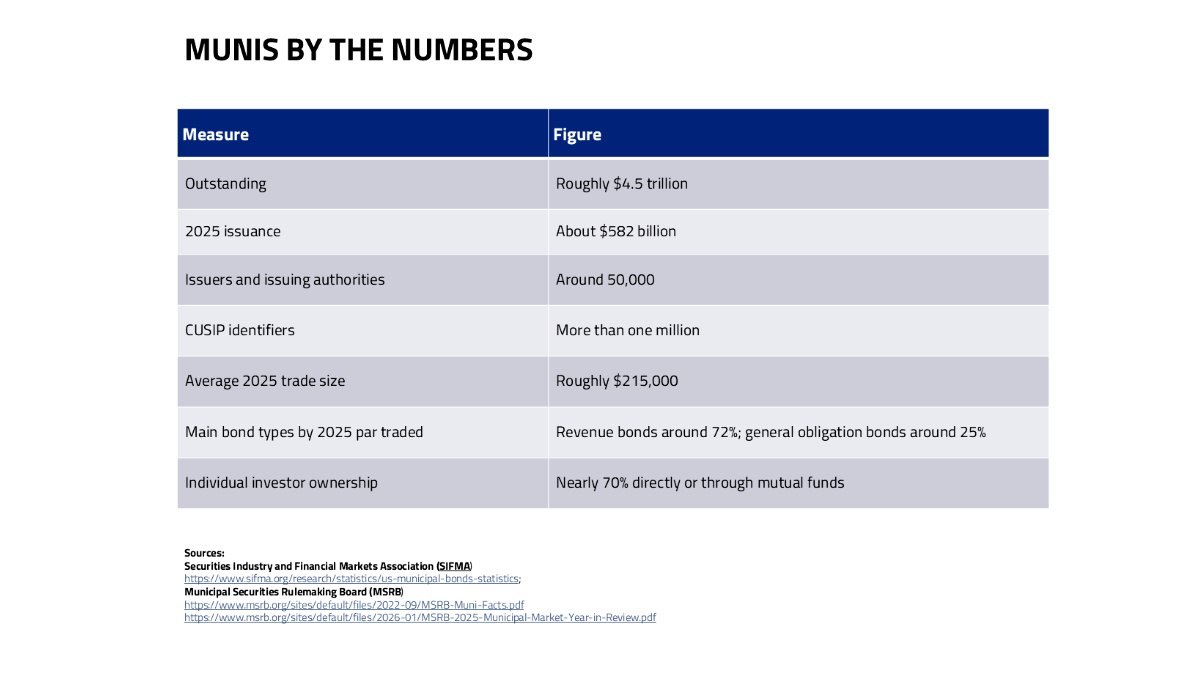 Those figures establish scale, not simplicity. Munis are too local, tax-sensitive, and legally specific to behave like a standardised benchmark product: a market national in size, but local in construction.
That structure matters for everyone, not just for readers looking at munis from abroad. The U.S. has not built one centralised local public-sector funding channel. It has allowed a vast capital market to develop around state and local finance, federal tax incentives, local legal authority, bond counsel, public projects, retail demand, dealer intermediation, and investor-specific tax preferences. Europe often treats local public finance as a public-sector funding problem. The United States treats it as a capital-markets problem. That creates complexity, but it also creates the conditions for a market.
A market of near-comparables
A muni specialist recently described individual municipal bonds to me as “snowflakes.” The concept is useful, even if the word now carries baggage. Munis are better described as a market of near-comparables: securities that look similar enough to invite comparison, but different enough to punish lazy comparison.
That distinction is more than semantic housekeeping. In corporate credit, the bond is often an expression of the issuer. In munis, the bond may be an expression of the issuer, the obligor, the project, the repayment source, the legal pledge, the tax status, the geography, and the investor’s own tax position. The issuer and obligor may not be the same. A general obligation bond is not a revenue bond. A toll road is not a school district. A hospital credit is not a water system. A New York tax exemption may matter to one buyer and be irrelevant to another.
None of this is overly esoteric to muni professionals; it is business as usual. For non-muni readers, however, it explains why munis have not automated as quickly as some of their fixed income cousins. The differences between bonds are not cosmetic. They are often the substance of the trade. If the instrument cannot be described consistently, it cannot be compared cleanly. If it cannot be compared cleanly, pricing becomes more interpretive.
The trade is downstream from the description. Munis are not difficult merely because they are illiquid. They are difficult because classification, comparability, tax treatment, credit analysis, and workflow all matter before the trade ticket is punched in the machine.
Retail DNA, institutional workload
The muni investor base is another reason the market behaves differently. Individuals dominate the market directly and indirectly, through household ownership, mutual funds, separately managed accounts (SMAs), exchange-traded funds (ETFs), and wealth platforms. This affects lot sizes, trading behaviour, liquidity expectations, distribution, product design, and the pace of electronification.
“SMAs bring individual tax and portfolio preferences at institutional scale. That can improve execution, but it also creates a heavier operational burden. The largest firms have built the infrastructure to cope; many regional and tier-two participants have not,” said a senior municipal portfolio manager.
The image of an individual investor buying a tax-exempt local bond and putting it away still lingers. In practice, a manager may now have to deliver income, tax efficiency, state exposure, maturity control, and direct ownership across thousands of accounts, each with its own restrictions, cash balances, ladders, and allocation constraints.
This is where the white-tablecloth promise of customised investing passes through the swinging doors into the kitchen of operations. A trade may be small in size, but large in operational consequence.
ETFs create a different pressure. They provide diversified exposure, intraday liquidity, and a more visible reference point for a market where many underlying bonds do not trade continuously. They also connect munis more directly to systematic liquidity provision, create-redeem activity, portfolio execution, and the need to move risk in baskets. ETFs do not simplify the underlying muni market. They make the quality of the underlying infrastructure harder to ignore.

Electronification is not the same as liquidity
It is tempting to measure muni “electronification” by asking how much volume is traded on screen. That measure matters because electronic volumes are rising. Alternative trading systems (ATSs), request for quote (RFQ) protocols, bid-wanted, auto-quoting, list trading, portfolio trading, evaluated pricing, and platform connectivity are all becoming more prominent. The danger is to treat the screen as proof that the market beneath it has changed uniformly. More electronic activity can improve access to liquidity, but it can also create more signals, duplicated flow, stale-price risk, and pressure on traders to decide what is genuinely actionable.
The better way to think about muni electronification may be as triage, not transformation: which trades can be automated, which can be assisted, and which still require judgment. High-grade, better-covered, more readily comparable bonds may be suitable for lower-touch execution, while more credit-sensitive bonds, with different coupons, call features, structures, and repayment risks, still require interpretation. Screens can make inventory easier to find, RFQs can speed up competition, bid-wanted can gather dealer interest, portfolio trading can help move baskets, and application programming interfaces (APIs) can reduce operational breaks. None of that turns every local credit, small line, odd lot, or idiosyncratic structure into a liquid benchmark bond. The test is not whether a trade touches a screen. It is whether the surrounding workflow becomes less manual, less duplicative, and less dependent on institutional memory.
Automation does not eliminate judgment; it relocates it. Security-level screening, pricing, and routine execution can increasingly be handled systematically across much of the high-grade market. Human attention then moves toward portfolio construction, larger or less liquid trades, lower-rated credits, and the exceptions where the cost of being wrong is materially higher.
The workflow has to remember
Discussing connectivity with a sell-side trader is not as thrilling as discussing the Knicks’ season. Connectivity is rarely just whether two systems can technically speak to each other. Imagine playing Wordle, but after each guess of the five-letter word, you had to start from scratch with no record of your previous guesses. That underlines the importance of meaning surviving the journey. A trade inquiry, a quote, a negotiation, an execution, and the subsequent allocations are not isolated events. They are stages in a process, and the process has to remember where it has been.
Connectivity without statefulness is only wiring. By statefulness, I mean the ability of the workflow to retain the relevant facts of the trade as it moves forward: what has happened, what can happen next, who is allowed to act, and what restrictions still apply. It is not glamorous, but neither are settlement instructions, reference data, or clean allocation logic. Market structure is often built out of boring things that stop being boring the moment they fail.
Munis need a non-theatrical way to move information and intent through the lifecycle of a trade without turning every missing detail into tomorrow morning’s clean-up exercise.
That is also why venues, execution management systems, and connectivity providers still matter. Direct bilateral connectivity sounds elegant until every protocol, field, counterparty permission, workflow state, and exception has to be maintained across several endpoints. In munis, the hard part is not only executing the trade. It is keeping the workflow coherent enough to survive contact with the real world.
The next efficiency gain is not another incremental improvement in RFQ speed. It is a portfolio-aware workflow connecting investor tax positions, cash needs, risk limits, available liquidity, pricing, compliance, execution, and allocation. Such a system could identify what should be traded, in what size, through which channel, and across which accounts, leaving the trader or portfolio manager to intervene where judgment adds value rather than manually coordinating every step.
Tokenisation as plumbing
Tokenisation belongs in this conversation only if it solves a lifecycle problem. The J.P. Morgan Quincy, Massachusetts transaction was interesting not because it made munis fashionable, but because it showed blockchain-based issuance and settlement being used in a live municipal bond transaction. The practical question is whether digital infrastructure can reduce settlement risk, improve transparency, clean up ownership records, and lower operational cost.
That is also why regulatory engagement and education matter. A market cannot adopt infrastructure it does not understand, especially when the issues involve settlement, custody, ownership records, and operational risk. Munis do not need digital terminology sprayed over old workflows. They need market participants to understand which problem a tool is solving. The most stubborn problems may sit less in secondary-market screens than in the older machinery of new issue distribution, allocation, and post-allocation processing.
AI after the drains are cleared
Artificial intelligence (AI) naturally appears in this discussion, and not without reason. A market with more than one million CUSIP identifiers, uneven data, complicated documents, fragmented liquidity, and a constant need to identify comparable bonds is an obvious candidate for better pattern recognition. Document analysis, evaluated pricing support, anomaly detection, relative value mapping, and workflow triage all look like sensible areas for machine assistance.

As Gregg Bienstock, advisor, municipal markets at SOLVE, put it: “Unlike some others, I am not of the view that AI will take the jobs of traders. AI, like other ‘new’ technologies that came before it, is another tool to make the user, in this case a trader or portfolio manager, better. We have seen clients use our AI-derived predictive price to bid more bonds, serve as an additional data point or guardrails. We have not seen the trader going the way of the rotary phone.”
The danger is to let the acronym arrive before the plumbing. AI may help identify a comparable bond, but it cannot decide on its own whether the comparison is valid. A model still needs clean reference data, reliable identifiers, legal structure, tax status, repayment source, sector mapping, call information, and workflow context. Without those inputs, it risks becoming a faster way to produce a more confident mistake, which is not innovation so much as automation with LED instead of incandescent lighting.
The useful output is not only a price but the confidence around that price. That should not replace dealer judgment. It should let dealers spend less time digging for the right comparison and more time deciding what that comparison actually means.
What should not be fixed
Any serious market structure discussion should also admit what should be left alone. Munis are local, tax-sensitive, legally specific, and tied to public projects, revenue streams, state law, and local economies. Some bonds trade episodically because that is how the investor base behaves. Some are owned to maturity. Some will not trade often because the natural seller and natural buyer do not appear on command every afternoon at 2:37.
That is not market failure. It is product reality. The goal should not be to make munis behave like Treasuries, or to force every bond into a continuous pricing fiction because the dashboard looks more impressive. Technology should make specificity easier to understand, price, trade, and manage. It should not pretend specificity can be erased.
The better version of muni electronification is therefore more modest and more useful. Better data, cleaner workflows, faster routing, stronger counterparty controls, scalable account-level execution, improved evaluated pricing, and direct connectivity do not flatten the market. They help participants cope with its shape. That may sound less exciting than revolution, but markets are often improved by practical irritations being removed one by one.
The U.S. municipal bond market finances American infrastructure. The next stage is the infrastructure of the market itself. That does not mean every bond becomes liquid, every workflow becomes automated, or every relationship disappears into a protocol. It means the market becomes more visible, more connected, more data-driven, and more manageable without pretending to be something it is not.
The point is not to make muni complexity disappear. The point is to make it tradable.
This article is part of a series from Brett Chappell:
• Private credit is moving from obscure to intelligible
• Low friction EM markets get an effective rate cut
©Markets Media Europe 2026