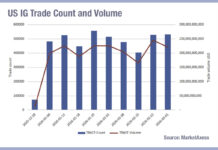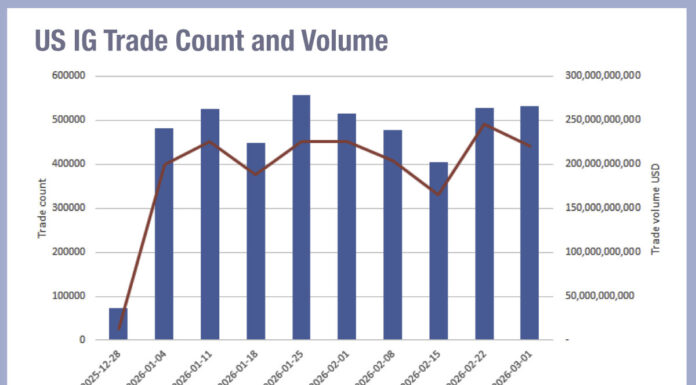





US corporate bond markets have seen volumes drop across investment grade and high yield trading in February 2025, however according to data from MarketAxess TraX, which monitors activity across markets, average trade sizes have not fallen, and trading costs have risen for IG whilst remaining flat for HY.

Trading in corporate bond markets typically follows primary market activity to an extent, due to the role that bond issuance plays in price formation and liquidity provision. Bonds trade more actively around a new issue, and activity typically quietens over time.
Where there is uncertainty around central bank rate decisions and economic uncertainty, firms’ funding requirements become more dynamic, as does their credit worthiness and the relative value of outstanding bonds vs. newly issued bonds.
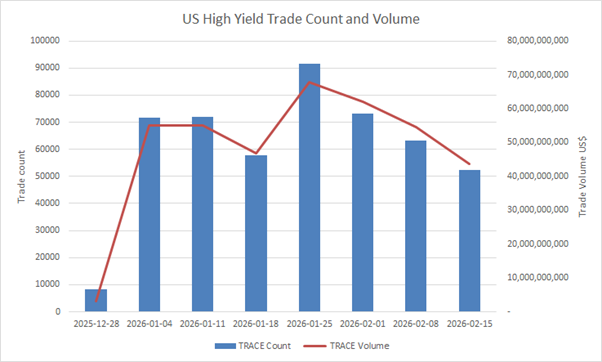
Nevertheless, the current pattern follows the norm, with two exceptional aspects. Trade sizes have been rangebound during this period, as have bid-ask spreads with 0.15-0.17 price % of par for HY and 0.08-0.09 price % of par for IG.
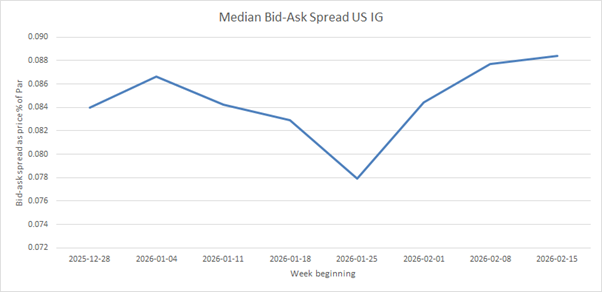
Although trading volume is not a direct proxy for liquidity, when correlated with trading costs, such as bid-ask spreads, it is possible to assess if the cost of moving risk is rising or falling with trade size movements.
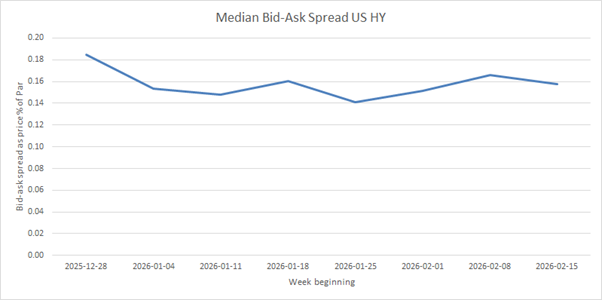
In this case as trade sizes have not changed, and bid-ask spreads have been range bound while both count and value traded have reduced, the implication is that falling activity is not impacting trading costs and therefore liquidity providers are not widening bid-ask spreads or decreasing trade sizes as volumes fall. While electronic liquidity providers (ELPs) have been very successful at cutting risk taking in market making, banks have increasingly stepped up to the plate.
The clear impact of this has been sustained liquidity provision at a steady price point across much of the US market, regardless of market activity.
Liquidity is particular to specific bonds, issuers, tenors and market makers, making the broad brush views of liquidity useful from a benchmarking point of view. However, clearly traders need to draw out the most detailed picture of the bonds they are trading. Markets are not bound by expectations, and many dynamics can impacting pricing and liquidity, making access to high-quality information key to optimising best execution,
©Markets Media Europe 2025