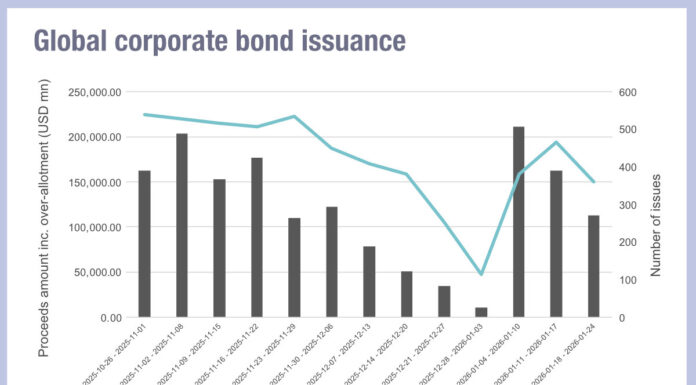





The failure to support policy and public announcements by the current US administration has hurt investors enough that they no longer react to public administration statements, preferring to wait on a more reliable indicator of reality. The uncoordinated, haphazard model of announcements, which can be made anywhere from social media posts directly by the president, to scheduled official publications and press conferences, makes the assessment of reality vs fantasy even harder.
Jerome Powell, chair of the Federal Reserve, said in a statement on Sunday 11 January 2026, “On Friday, the Department of Justice served the Federal Reserve with grand jury subpoenas, threatening a criminal indictment related to my testimony before the Senate Banking Committee last June. That testimony concerned in part a multi-year project to renovate historic Federal Reserve office buildings.”
The news quickly drew condemnation from some quarters within the US administration and support for Powell from others.
“We stand in full solidarity with the [US] Federal Reserve System and its Chair Jerome H. Powell,” wrote 14 central bank heads, in a statement on Tuesday, 12 January 2026.
Markets did not respond to this unprecedented turn of events. For example, the US Treasury’s par yield curve for government bonds showed no unusual activity on Monday on or Tuesday across the range of tenors.
“US stocks and bonds rebounded from early losses on Monday, despite the investigation by the Department of Justice into Federal Reserve Chair Jerome Powell,” wrote UBS in its ‘house view’ commentary this week. “The S&P 500 rose 0.2% to a fresh all-time high, and the yield on the 10-year US Treasury held below 4.2%.”
This might seem surprising because the investigation of Powell’s testimony is believed by some, including Powell himself, to be driven by the desire of the current US president to drive down interest rates more quickly than the central bank is currently doing. Having rates determined by political expediency and not economic drivers is a major concern for markets. That would directly affect currency values, bond markets and inflation.
The current US president, who appointed Powell as Fed Chair, has threatened to fire Powell, has said he is “incompetent”, and has also denied to reporters that he is behind the investigation brought against Powell, led by Jeanine Pirro, United States Attorney for the District of Columbia.
Powell said in response that this dispute over rates cuts is the clear reason behind the case. As a Federal Reserve chair can only be fired for “cause” an investigation of the type proposed could be supporting material for Powell’s removal.
“The threat of criminal charges is a consequence of the Federal Reserve setting interest rates based on our best assessment of what will serve the public, rather than following the preferences of the President,” he wrote in his statement. “This is about whether the Fed will be able to continue to set interest rates based on evidence and economic conditions – or whether instead monetary policy will be directed by political pressure or intimidation.”
Disbelief
If this prosecution is driven by a need to speed up rate cuts, it would seem doomed on several fronts. Some economists believe that rate cuts will actually be pushed out this year, more slowly than previously expected, as Vishwanath Tirupattur, Morgan Stanley’s chief fixed income strategist, explained in the paper ‘Morgan Stanley Global Macro Forum Where Next for the Fed?’, on 12 January 2026.
“We now look for 25bp rate cuts in June and September (versus our prior call for cuts in January and April),” he said. “Given the improved economic momentum and the decline in the unemployment rate, we see less need for near-term cuts to stabilise the labour market. Instead, we now think the Fed will cut rates as it becomes clear tariff pass-through is complete and inflation is decelerating toward the 2% target. We expect disinflation to begin in Q2 2026 with year-on-year rates of inflation slowing around mid-year. Our outlook for the terminal target range remains unchanged at 3.0-3.25%”
UBS notes that markets do not believe the investigation will “materially alter the likely path for Fed easing this year” despite potentially creating uncertainty around timing of any changes in leadership at the central bank.
“We expect monetary policy to continue to be shaped by the health of the US economy, with today’s inflation data a key focus,” UBS writes. “Pushback from Congress and the long tenure of Fed board members suggest that any changes to the central bank’s policymaking framework should be gradual. The Senate plays a key role in personnel outcomes by confirming the nominations of future governors and the next Fed chair, and multiple Republican lawmakers have voiced their concerns over the probe.”
Then there is the history of failure to support grand jury investigations by the current administration, such as the cases against New York attorney general, Letitia James, and former FBI head, James Comey, which were dismissed in November 2025, because the attorney in charge of the case, whose appointment was publicly advocated by US president, Donald Trump, on social media, was found to have been unlawfully appointed.
©Markets Media Europe 2025