



JPMorgan had the largest fixed income, currencies and commodities (FICC) revenues amongst US banks at US$5.4 billion for the last quarter of 2025 with Goldman showing the strongest year on year growth on rates and FX trading. Citi and BofA FICC results were broadly flat; Morgan Stanley’s numbers lagged in absolute terms at US$1.8 billion and were also down 5% year on year (YoY).
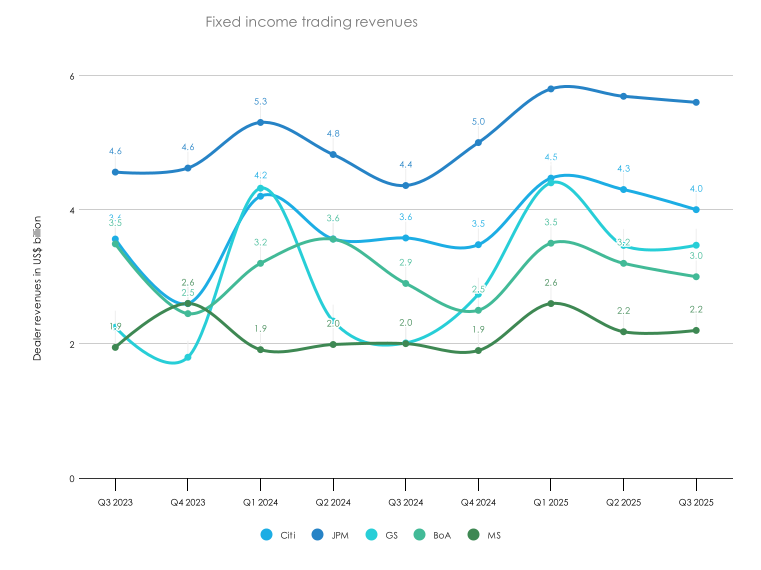
JPMorgan’s $5.4 billion of fixed Income revenue in Q4 was down 4% from Q3’s US$5.6billion and up 7% year on year (YoY) versus Q4 2024.
Chief financial officer (CFO), Jeremy Barnum, said: “Fixed Income was up 7% year-on-year, with strong performance in securitised products, rates and currencies and emerging markets, largely offset by lower revenue in credit trading.”
Goldman Sachs posted $3.1billion in FICC down 11% quarter on quarter (QoQ) but up 13% YoY.
During the bank’s earnings call, CFO Denis Coleman explained the driver of this growth YoY saying: “Intermediation rose 15% year over year, driven by rates and commodities, while FICC financing increased 7% to a new record.”
Citigroup had revenues in FICC at US$3.5 billion versus US$4 billion in Q3; with revenues flat YoY. Management said the quarter’ performance reflected tough comparables from 2024.
Their CFO, Mark Mason, said: “Fixed Income revenues were down 1%, with rates and currencies flat and spread products and other fixed income down 1%.”
Bank of America’s Q4 came out at US$2.5 billion vs US$3 billion in Q3, and flat YoY. CFO Alastair Borthwick’s summary was laconic in his commentary: “FICC revenue grew 1%, driven by improved performance in macro rates and FX products, offsetting a modest decline in credit products.”
Morgan Stanley’s FICC revenues lagged its larger competitors coming out at US$1.8 billion down from US$2.2 billion in Q3, and down 5% YoY. The firm emphasised full-year platform strength and the broader investment-banking recovery rather than any standout Q4 FICC theme.
Its CFO, Sharon Yeshaya highlighted the weakness in commodities trading explaining: “Commodities results declined primarily due to lower power and gas revenues.”
Banking analysts at Morgan Stanley summarised the quarter in FICC trading saying: “For most banks macro (rates, FX) trading was stronger than credit.”
©Markets Media Europe 2026