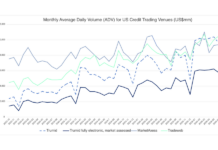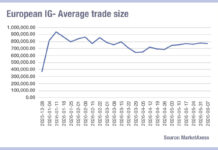





The Trump administration’s love of shaking things up each April – and then backing off again in response to the apparently unexpected results – allows us to look at the market response to increased inflation and vol due to a range of causes, from trade taxation to warfare in major oil economies from one year to the next, using data from MarketAxess’s TraX and CP+ services which track activity across markets.
Last year we wrote “European bid-ask credit spreads not assuaged by tariff rollback”, when we analysed market conditions following the April 2025 tariff shock. The parallels and contrasts with 2026’s Iran war and oil blockade are striking.
European IG credit bid-ask spreads hit 59% over their year to date (YTD) average in the first week of April 2025, and even after the tariff rollback remained 10% above their YTD average. In 2026, EUR IG spreads followed a very similar arc – hitting their worst levels in late March and only partially recovering by late April. In both years, European markets were notably slower to normalise than US markets after the stress event. We noted that the substantial fall in the cost of liquidity in the US market was not mirrored by European bonds. That reflects the difference in credit concerns for Europe, and the capacity of brokers to deliver better pricing at lower costs in the US, as a result of a more homogenous market and less competitive pressure. That structural difference is equally visible in the 2026 data.
In 2025, we noted that US high yield (HY) was identified as an outlier. Average trade sizes fell even as bid-ask spreads tightened relative to the YTD average. We noted that divergence was nuanced and potentially concerning. In 2026, US HY shows no such anomaly: sizes and spreads have recovered together cleanly, suggesting a more orderly normalisation. The 2026 stress episode, while synchronised across markets, appears to have been absorbed more smoothly in US credit than the 2025 tariff shock, in part because the electronic infrastructure is deeper and the dealer community was better positioned, but also reflecting the economic effect on oil importers e.g. Europe over oil exporters e.g. the US.
The EUR IG trade size compression is the most notable continuation across both years. Our 2025 article observed that following April turbulence, most markets saw average trade sizes rise again, but US HY saw average trade sizes fall. This was a market-specific quirk in 2025. In 2026, it is EUR IG that exhibits the persistent size compression, even as its bid-ask spreads normalise. This seems to be a structural feature of European credit, that outlasts the immediate stress period in both years: dealers and participants reduce their trade size footprint and are slow to rebuild it, even after bid-ask spreads recover to normal levels. This is likely to reflect the pressure that
Our article concluded that “seeing these very nuanced perspectives, it emphasises the need for traders to have accurate pre-trade data when engaging with turbulent markets, to understand the risks of market impact and an understanding of the size of trades that can be executed effectively.” That conclusion applies equally in 2026 — and the EUR IG data in particular reinforces it, since a trader relying only on spread data would conclude liquidity has fully normalised, while the trade size data suggests the available depth per transaction has quietly contracted.
©Markets Media Europe 2026