




Although Europe has seen lower-than-expected issuance volumes, according to sell-side analysts, there are positive moves into euro issuance, such as those by US fimrs, the ‘reverse Yankee’ and potentially by UK firms if political uncertainty continues to bear down upon the pound sterling.
“If you look at issuance numbers for the month of March, it was surely lower volumes in terms of bond issues in the Euro market, maybe with the exception of one larger trade in March, which was from Amazon,” says Mike Koerkemeier, ING’s global head of Capital Markets. “You could see these revert Yankee trades from large names in the US, whether it was Alphabet or Amazon. Meta did a massive trade in the US that was all AI driven, and that really brought the volume up on the Euro side. Traditional euro issues were relatively quiet in the month of March.”
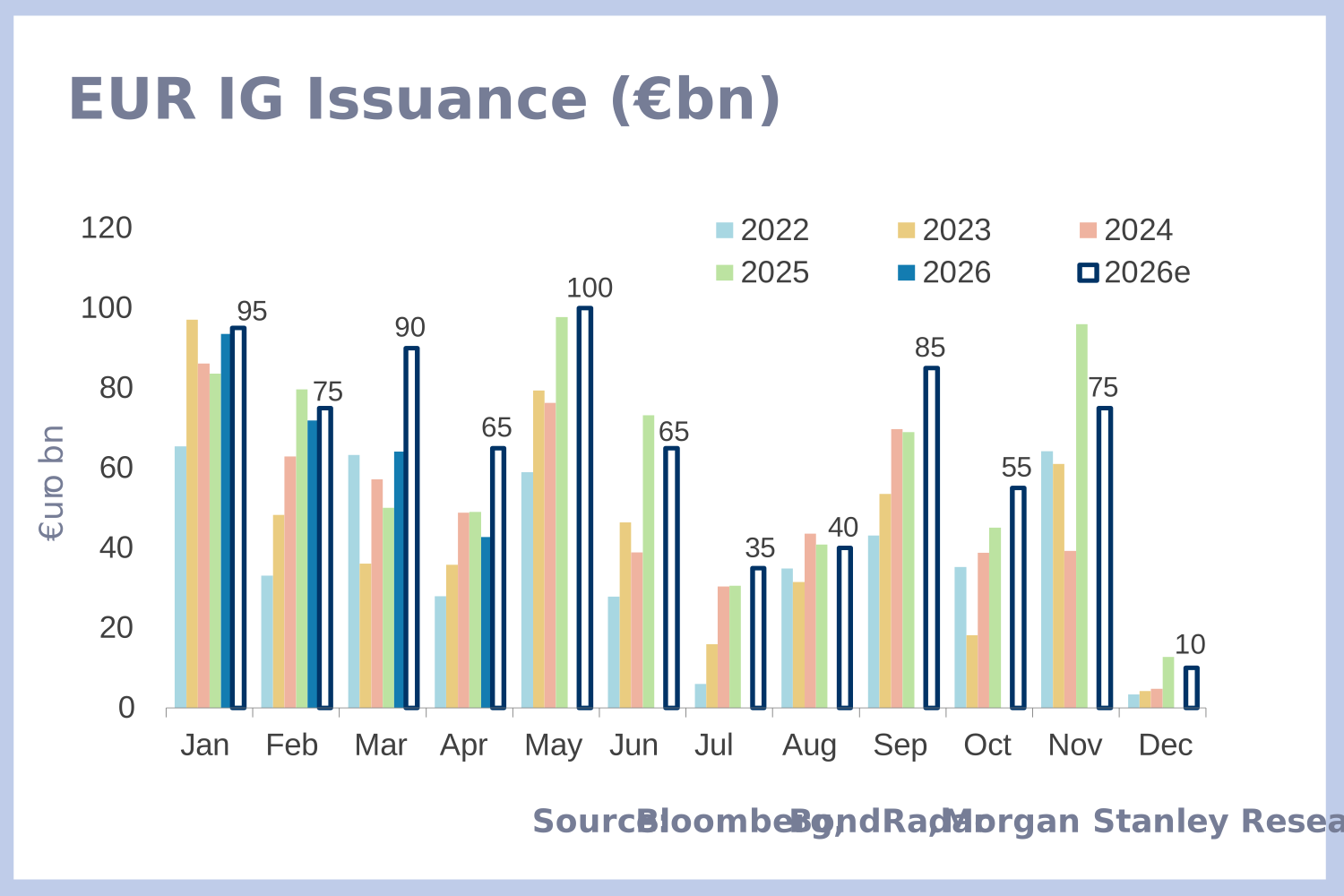
Activity picked up again in April, he noted, with positive investor feedback, new issue premia for trades which were over-subscribed.
“All of these points us to assess that we’re actually in green territory, if you want to call it like that, and not only for investment grade corporate, for FIG, for SSA, but also the higher beta trades on the high yield side, which is a bit more complex.”
Morgan Stanley strategists, Aron Becker, Ellie Dann, Yagyesh Modi and Jonathan Loke wrote on 1 May 2026, “The aggregate measure points to growth in the Euro Area stalling in Q2 2026, according to our economists.”
However, they also note mixed signals from a credit perspective, with services badly hit and manufacturing PMIs being “robust”.
“We expect EUR IG issuance to accelerate to €100 billion in May, split 35/65 between financials and corporates,” they wrote. “We think reverse Yankee issuance will be a key contributor this month, which is so far on track to reach our annual forecast of €180bn, a record high. Seasonally, May also tends to be particularly busy for US corporate issuance in EUR, which historically accounted for 14% of annual supply.”
Yet with the ECB potentially hiking rates to counter inflation, the European economy worsening over the next three to six months and an existing oil supply bottleneck that has already been put in place, the continent could see worsening credit conditions in a rising rate environment, risks still exist warned Dimis Theodorou, head of UK Debt Capital Markets Syndicate at ING.
“What urges me to tell borrowers to move into the market, or at least stress that there’s a risk there, is that this could unravel quickly,” he said. “We’re seeing cracks on the edge of this. Last week, you saw significantly higher PPI numbers in the US. Inflation is rearing its head in some of the Asia economies, and arguably economies which are more reliant on that export challenge from the Middle East, are having to pre-emptively hike rates. We’re already seeing central banks hike rates, we just haven’t seen the big three do anything yet. It’s a risk, it’s not showing up yet, but it could absolutely.”
Noting that Sterling is still very functional as a market, he acknowledged caution also exists there, with politics as well as war playing its part, but was less convinced that ‘reverse Cockney’ issues from UK corporates into euro would be needed.
“We’ve executed a subordinated trade for Lloyds in Sterling, where we were able to execute efficiently,” he said. “I think the Sterling market’s focus is clearly around what’s going on with politics, and that’s going to influence the path of gilts. You have a market arguably paying a lot more attention to local dynamics as well as clearly what’s going on with the with the [Middel Eastern] war, because we can’t ignore the fact that energy prices in the UK are going to be impacted by what’s going on there.”
©Markets Media Europe 2026