




Mexico has faced a sharp deterioration in its sovereign credit standing within the space of just two weeks in May 2026, with two major agencies acting in quick succession. Their decisions highlight several pressures upon the country’s economy, including structural fiscal weakness, slowing growth, state-enterprise dependency, and external trade uncertainty.
Electronic trading platforms have seen a shift from net buyers to net sellers of government debt following the news, and buy-side traders would do well to consider how to best support their portfolio managers going forward.
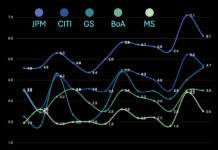
Morgan Stanley analysis on 1 June calculated that the aggregate fund position on Mexico had fallen 0.33 percentage points to 0.59% overweight over the previous month.
Absent a big directional move, asset management with discretionary ownership of Mexican debt will now have the chance to position themselves over time as the situation changes, limiting pressure on trading desks, and giving buy-side traders the opportunity to pick as and when they choose to execute.
The greater risk for PMs will be the potential for a move from investment grade (IG) debt to high yield (HY), which would force portfolio managers into trading according to their fund’s mandate.
The rating analysis
Taking a step back, S&P made the first call on Mexico’s rating on 12 May, when S&P Global Ratings revised Mexico’s outlook to negative from stable, while affirming its BBB long-term foreign currency and BBB+ long-term local currency sovereign credit ratings. The agency cited the risk of very slow fiscal consolidation, largely due to weak economic growth, which could lead to a faster-than-expected buildup in government debt and a higher interest burden. It noted that Mexico’s low per capita growth remains a key ratings constraint, while soft economic activity, rigid spending, and the weak financial position of the country’s largest public-sector companies are eroding fiscal flexibility and pushing up debt levels.
Moody’s followed on 20 May when it downgraded Mexico to Baa3 from Baa2, while revising its outlook to stable from negative. This dropped the country to the lowest tier of investment grade, just one notch above junk status. It said that the decision reflects a sustained weakening in fiscal strength that accelerated in 2024 and is expected to persist, with the agency citing government spending levels, a narrow revenue base, and continued fiscal support for Pemex as factors limiting the government’s ability to stabilise its debt. Moody’s also noted that the government’s policy priorities — including pursuing energy sovereignty and a redistributive spending model — had weakened the fiscal outlook.
Fitch, meanwhile, has kept its rating unchanged since 2020, reaffirming Mexico as BBB- on 10 April.
Near term shifts in selling activity

Morgan Stanley’s strategist, Simon Weaver, wrote on 26 May, “While the rating trend for Mexico remains negative, we don’t see further negative rating changes in the next year and have high conviction in our base case of Mexico still being IG for at least another two years. With markets already pricing another two downgrades, we see Mexico as too cheap.”
Looking further out, he was less confident, suggesting a more sustained fiscal effort would be needed to ‘guarantee’ IG status for two years or more, and that is more than the banks projects to be likely, notably if Petroleos Mexicanos (Pemex) performance continues as is.
Anecdotally, The DESK has heard that a slowdown in sovereign buying has been taking place, reflected in the Morgan Stanley stats, due to the war uncertainty and the closure of Strait of Hormuz driving up inflation, while impacting economic activity in the country with downward revisions in GDP growth down to 1.1%.
Local onshore investors had been well positioned going into this year with low expectations of continued easing, while global investors are cautious around Mexican bonds, given the economic outlook and continued uncertainty in the Middle East. The year is still net positive however in inflows based on the heavy flows early in the year.
Electronic trading has seen a change in activity following the amendments to the country’s rating; in Mexican USD sovereign bonds, the ratio of 49%/51% buyers to sellers in April on MarketAxess shifted to 51%/49% buyers to sellers in May.
For local currency bonds, Mbonos, the ratio of 46%/54% buyers to sellers to April on MarketAxess slowed to 49%/51% buyers to sellers in May, suggesting opportunities were created in peso-denominated debt.
Warning signs
The ongoing substantial support for Pemex and Comision Federal de Electricidad (CFE) is a problem for Mexico’s fiscal limitations, although neither is formally guaranteed by the government.

“Our forecast assumes that all of Pemex’s debt amortisations will be financed by central government transfers,” wrote Manuel Orozco, at S&P Global, on 12 May 2026. “However, poor operational results at Pemex could prompt the government to provide more funds to cover future financial losses, widening the fiscal deficit. Moreover, we will continue to monitor the potential impact of the government’s ambitious infrastructure plans on Mexico’s deficits and debt trajectory.”
The government channelled around $35 billion to Pemex in 2025, roughly 1.9% of GDP, and budgeted $14 billion more for 2026, with Moody’s expecting further support to follow. On the fiscal trajectory more broadly, S&P expects the general government deficit to remain at 4.8% of GDP in 2026, with net government debt forecast to rise from 49% of GDP in 2025 to around 54% by 2029.
Moody’s lowered its real GDP growth forecast for Mexico to below 1% for 2026 and projected 1.3% for 2027, warning that long-term expansion remains constrained by high economic informality, insecurity, and infrastructure bottlenecks. Trade uncertainty compounds the picture, with both agencies flagging the 2026 USMCA renegotiation as a potential risk to investor confidence and long-term economic stability.
This marks the third downgrade of Mexico’s sovereign rating by Moody’s in recent years, following cuts in April 2020 and July 2022. With Moody’s now aligned with Fitch at the lowest investment-grade rung and S&P’s outlook negative, the prospect of Mexico losing investment-grade status altogether is a big worry for bond investors.
Buy-side traders can track activity on electronic platforms to assess just how far sentiment is changing in the short term, and to assess how effective their liquidity access will be as their PMs make calls on the longer term trends; big macro impacts could fundamentally change sentiment either way.
©Markets Media Europe 2026