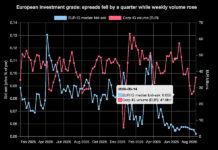






The US Treasury market is the foundation for corporate bond market liquidity. When that foundation shakes, the tremors can quickly move into the credit markets.
The Treasury sell-off by investors and overseas central banks seen in the market this year, as a result of the Iran conflict and erratic US leadership, can be compared with that of April 2025, when the US administration surprised the markets with massive import taxation, triggering tariff shock and a sudden reassessment of US fiscal credibility. That event offered a test of just how that transmission from Treasuries into credit can work.

After the 2 April 2025 tariff announcement, Roberto Perli, manager of the System Open Market Account, speaking at the Federal Reserve’s 8th Short-Term Funding Markets Conference, said, “All told, by 11 April, longer-term Treasury yields were about 30 basis points higher than their 2 April level. Interest rate volatility rose significantly and prompted a notable deterioration in Treasury cash market liquidity, meaning that it became more difficult and costly to transact in Treasury securities.”
The mechanism by which Treasury stress becomes stress is well established and operates at a speed that can surprise market participants.
The first channel is the benchmark repricing effect. The Treasury market provides the benchmark risk-free yield curve for pricing risky assets, so when yields spike and become erratic, every credit instrument priced off that curve is simultaneously repriced. For investment-grade and high-yield borrowers, that can mean higher all-in borrowing costs in a very short space of time.

“US corporate spreads have widened significantly, increasing to 120 basis points for investment-grade and 461 basis points for high-yield bonds. This abrupt shift has coincided with the announcement of new tariffs by the US administration, which has triggered a sharp deterioration in market risk sentiment,” wrote Mar Domenech Palacios and

Martina Jančoková of the European Central Bank shortly after the tariff announcements in 2025. “As a result, the market appears increasingly sensitive to macroeconomic and policy developments, raising the risk of heightened volatility and a stronger response to future shocks as sentiment continues to adjust.”
This was a sharp reversal from spreads that had been near two-decade lows only weeks earlier.

The second channel runs through dealer capacity. As Nellie Liang, senior fellow in the Hutchins Center on Fiscal and Monetary Policy in the Economic Studies, has observed, traditional primary dealers have increasingly been replaced by electronic market makers in the Treasury space, who have smaller capital cushions and provide more efficient trading but do not typically have client relationship with buy-side firms. When volatility spikes and intermediaries reduce their appetite to hold risk on their balance sheets, the wider Treasury spreads eat into the margin available for dealers to intermediate credit, potentially hurting liquidity precisely when it is most needed.
The third and most dangerous channel is the risk of forced selling due to market interconnectivity. The basis trade being used by leveraged hedge funds’ made up short positions on Treasury futures at around US$1 trillion in March 2025. A disorderly unwind in positions of this type could have cascading selling pressure across both Treasuries and the repo market that funds credit positions. Although such risks are more situational, market participants need to be aware of these capital flows.
The Treasury Borrowing Advisory Committee has noted that unusually high headline risk adds incremental risk premia in the US Treasury market, impacting market participants’ confidence in owning and intermediating Treasuries. For credit markets, that confidence can directly hit market liquidity.
Market structural changes also facilitate liquidity in the credit markets. Having connectivity between rates and credit trading, and the dealer-to-dealer and dealer-to-client markets can better support dealers putting on and taking off risk positions. Auto trading increases ongoing two-way liquidity and reduces the need to execute larger blocks of bonds.
“Market liquidity has also experienced periodic disruptions, as shown above, and faces the ongoing challenge of growth in Treasury debt outstanding amidst limited dealer capacity,” wrote Michael Fleming, head of Capital Markets in the Federal Reserve Bank of New York’s Research and Statistics Group in September. “At the same time, policymakers have taken many steps to promote Treasury market resilience. It remains to be seen how these various developments will affect market functioning and liquidity.”
©Markets Media Europe 2026