




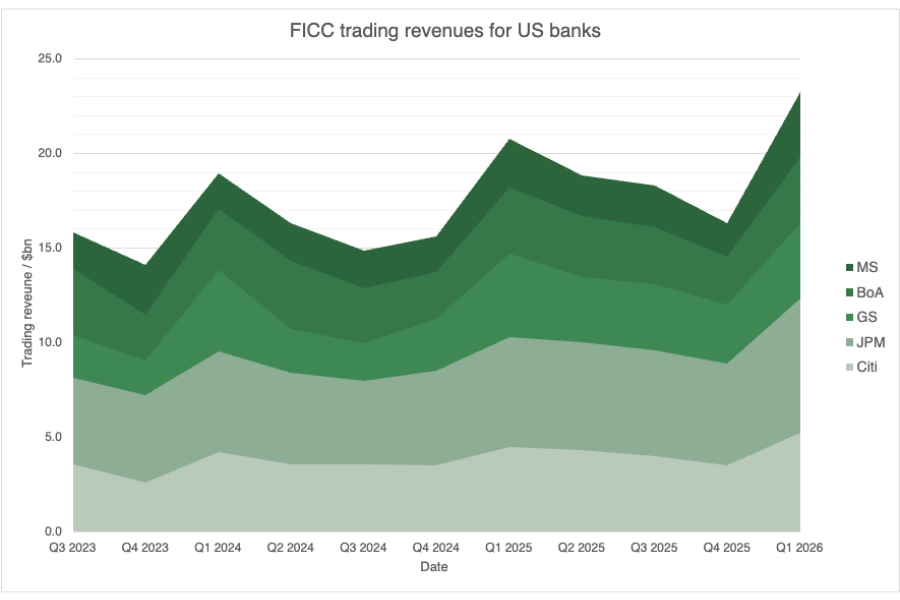
S&P Global analysts have warned that global banks’ financing of market makers is increasing profits but also ratcheting up risk – while US banks’ fixed income trading revenues spiked in the first quarter of the year.
In 2025, markets financing income at Barclays, BNP Paribas, Goldman Sachs and Morgan Stanley was up 25% year-on-year (YoY) to a collective US$24 billion, according to S&P Global, with the latter leading the charge. As banks lean more on trading firms for their profits, those firms are eating up their liquidity.
“Individually, each relationship and trade may generate only limited needs. Together, however, they create significant aggregate risk across the balance sheet,” analysts warned.
S&P Global’s report argues that opaque sovereign cash-futures basis trades by hedge funds are driving an increase in leverage. Citing Federal Reserve data, it stated that the average hedge fund is approximately 10x levered – “the highest in years, [coinciding] with significantly elevated asset prices after a year of rising volatility.” This situation could threaten sovereign debt markets’ stability, and potentially harm banks’ balance sheets if stress spikes, it said.
Over Q1 hedge funds reduced UK gilt holdings by 21% in light of the Middle East war, per Bank of England data. “Even though repo markets were able to absorb this, unwinding was rapid and shows the potential for hedge funds to amplify volatility,” S&P noted. “The failure of a highly leveraged trading firm could have outsized effects.
“Banks’ complex relationships with [market making firms] will continue to deepen, evolving with the market structure and needs,” S&P Global predicted. “This will consume bank liquidity over the short term and increase funding needs over the medium term.”
Morgan Stanley reported meteoric growth in fixed income trading revenues over the first quarter of 2026, with US$3.4 billion representing an 88% quarter-on-quarter (QoQ) and 30% YoY increase. Yet its success was not enough to get it ahead of its US peers.
The bank has sat in fifth place on the totem pole since Q1 2024, although this quarter’s results have significantly narrowed the lag behind its closest competitor, Bank of America.
“Fixed income revenues were a post-crisis record at US$3.4 billion. Microresults increased meaningfully YoY, driven by securitised products and credit corporates,” stated chief financial officer Sharon Yeshaya during the bank’s results call.
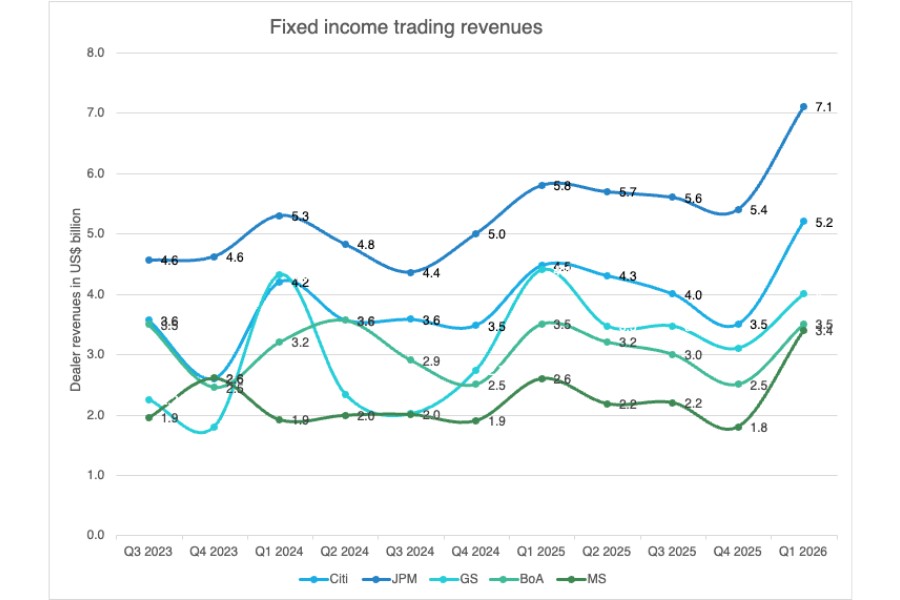
BofA’s results were strong on a quarterly basis – up 40% – but remained static YoY at US$3.5 billion. Lower revenues were seen in interest rate products, the firm said.
At Goldman Sachs, revenues rose with the pack QoQ, up 29% to US$4 billion. But YoY, figures fell 9%, making it the only bank of the cohort to decline on a yearly basis.
“Performance in rates and mortgages was relatively lower [in Q1],” said Denis Coleman, chief financial officer, during the bank’s results call. “That was basically just a function of the overall environment making markets.”
“Borrowing [was] up across rates [and] commodities. Volatility across rates and commodities went up, and that is what mathematically drives the change in the VAR rate.”
“FICC performance has to be put in context,” CEO David Solomon added. “We could not have had a quarter like this 15, 20 years ago because FICC was such an important component of the business. It’s now a much more diversified business.”
“FICC performed well in the quarter,” he affirmed.
Despite falling revenues for Goldman, it held its third-place position in the rankings.
Citi pulled away from the pack slightly thanks to its 49% QoQ and 16% YoY growth, reporting US$5.2 billion over the quarter.
Chief financial officer Gonzalo Luchetti explained, “Rates and currencies was up 6%, driven by FX on higher volumes and optimisation of the balance sheet, largely offset by rates. Spread products and other fixed income were up 27%, primarily driven by strong growth in commodities.”
Remaining ahead of its peers, JP Morgan far exceeded its competition in fixed income trading revenues over the first quarter of 2026, retaining the lead it has held since pre-2023 – despite a faltering performance in rates.
“[Results were] driven by higher revenue on strong client activity in commodities, credit and currencies and emerging markets, as well as continued strength in securitised products, [and] partially offset by lower revenue in rates,” the bank said in its earnings presentation.
©Markets Media Europe 2026